
Colerain resident discusses need for local pollinator gardens
Trending
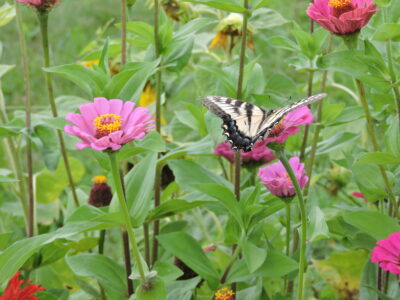
COLERAIN -- Sandy Putorek of Colerain started her pollinator garden and monarch butterfly habitat four years ago on her 30-acre lot.
Putorek said that she grew up on the property where the garden is located.
"I guess I was very intimate with nature ever since I was a child, and I lived very close to nature. I spent a lot of time in the woods as a kid. I grew up with it," she said.
Putorek said she started her pollinator garden after learning about a program through the Natural Resources Conservation Service of the U.S. Department of Agriculture. She said the Environmental Quality Incentives Program provided her with technical and financial assistance when she first started the garden.
Putorek said that the USDA helped her get the plants that she needed for the garden and reimbursed her for a large portion of the cost.
"They will work with you. ... They'll tell you what grasses, what flowers you need -- and some are legumes -- and how much you need. Then they give you a list of nurseries, and I ordered mine from the Ohio prairie nursery, which is in central Ohio, and it was $400 worth this seed. Then they work with you, and I got $348 back from the USDA, so it's not real expensive."
Putorek said that gardeners are not limited to the plants that the USDA requires. She encourages gardeners to buy a large variety of plants and flowers on their own as long as the plants are native to the area.
She said that pollinator gardens can be any size, and gardeners who live in suburban areas can even have a small strip of plants along the side of their house or driveway.
"You don't have to live in the country to do this. You can in Martins Ferry or you can live in Bridgeport. You can do it as small or as big as you want," she said.
She also said that the planting process was simple other than clearing the weeds off of her lot. She said that she just had to scatter the seeds on her property and did not have to bury them.
Putorek's garden is also a registered habitat for monarch butterflies known as a Monarch Waystation under Monarch Watch, a nonprofit education, conservation and research program based at the University of Kansas that focuses on the monarch butterfly, its habitat and its fall migration.
Putorek said that the main requirement for being a Monarch Waystation is growing a lot of milkweeds which are host plants for monarch caterpillars and nectar plants for adult monarchs.
She said that monarch butterflies and caterpillars have a lot of predators, which is part of the reason why their numbers are at an all-time low.
"Mother Nature is cruel, beautiful but cruel," she said.
Along with butterflies, Putorek also hopes to help the bee population as well as other pollinators such as flies, wasps and beetles.
Putorek explained that she is mostly concerned with saving bees that are native to North America. She said that there are currently 5,000 species of native bees in North America including 50 species of bumblebees and species of mason bees, squash bees and carpenter bees. She said that two species of bumblebees have already gone extinct, and one species is endangered.
"Most people think that honeybees pollinate everything. Now, honeybees are native to Asia. From Asia, they took them to Europe, and the colonists brought them to North America when they came over. Before that, the native bees pollinated everything. We don't really need the honeybees, but the honeybee is the only insect that people have domesticated because, you know why, honey," she said.
Putorek said that she grows plants to attract many native species of bees.
"Everything I grow is for the birds and pollinators," she said.
Putorek said that she has noticed many people moving to the Colerain area and building on the lots close to her house.
"I could be a millionaire if I sold lots, and you have to have a 2-acre lot up here to build a house, but I choose not to do that. I feel like when I was a kid, I was so close to nature that I want to protect it," she said.
Putorek also said that gas and oil companies are fracking near her property. She said she refused to have any pipelines on her property, but she worries that fracking will have a negative impact on nature and the environment.
Putorek also said she encourages people, especially those who live on larger lots, to limit the number of times they mow their lawns.
"Your mowed lawn is a desert of death for our pollinators. They cut out the dandelions, the white clover and the red clover. There's nothing there for the pollinators. When you get 2-acre lots all over the United States, you got millions of acres of, like, desert. That's why we're losing our pollinators," she said.
Putorek said that she recently taught a pollinator class at a small church in St. Clairsville. She hopes to teach more classes in the future, including classes for children. She recently had a small greenhouse built on her property and wants to sell native plants to members of the community.
Putorek said she hopes to inspire and educate others on how small actions can make big impacts on the environment.
"The way we live is totally destructive to the world in which we live," she said.
Putorek said that anyone who is interested in starting a pollinator garden should contact Gina Hammond, district conservationist of the USDA, at 740-619-3002.
Anyone interested in creating a Monarch Waystation can contact Monarch Watch by calling 785-864-4441, sending an email to monarch@ku.edu or going online to monarchwatch.org.