
$4-million reclamation project complete at Friendship Park
Trending
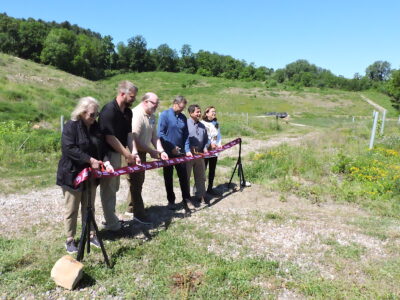
SMITHFIELD -- Members of the Friendship Park board were joined by state and federal officials Thursday to celebrate the completion of a $4 million project that included the replacement of 3,250 feet of coal mine high walls with 8,070 feet of trails surrounded by 34 acres of scenic prairie and wetlands.
In addressing those gathered for a ribbon cutting at the site, park board President Roger Hilty noted that in observance of Earth Day, seeds for 4,000 trees were planted at the site on April 23, 2022, by many volunteers, for whom it has been dedicated.
Hilty said the effort should yield hundreds of trees, contributing to the beautification achieved through the project, which has been in development since 2021.
Tom Shaw, regional director for the U.S. Department of the Interior, noted it was supported by federal money issued through the Ohio Department of Natural Resources' Abandoned Mine Land Economic Revitalization program.
Shaw added it has won the federal Office of Surface Mining and Reclamation and Enforcement's National Award as the highest-rated reclamation project for the year.
Ben McCament, chief of ODNR's division of mineral resource management, said the AMLER program's goal is to address safety issues arising from former mine lands while sparking the local economy.
He said trails created with the reclamation will help to attract more visitors to the park as well as local businesses.
The project included the creation of 15 parking spaces at new trail heads on both sides of county Road 23.
Hilty said when dozers first arrived at the park, rumors arose that the board was allowing an oil line to be built through it, but the group's actual goal was to restore natural wildlife to an area that had been unusable since coal mining there ceased in 1959.
High walls are steep, exposed cliffs left following mining operations conducted before environmental laws were in place. They can be at risk of collapsing.
Jeffrey Clarke, an environmental specialist with the ODNR, said heavy machinery was used to remove cross-sections of high wall standing 40 to 50 feet high from the south side of the park to the dam on the lake.
Clarke said about 700,000 cubic yards of material from the high walls was used to level the property below, as needed, before vegetation natural to the area was planted.
He added crews also created two ponds fed by natural streams and groundwater, both designed to draw natural wildlife.
Park board member Judy Henthorn noted the new trail includes two bridges extending across the wetland areas.
Henthorn said she would like to add to the site bluebird nest boxes and blue lupine flowers, which are eaten by Karner blue butterflies, an endangered species.
Shaw noted $11.2 billion has been earmarked for abandoned land mine programs for the next 15 years through the federal Infrastructure Investment and Jobs Act.
The Friendship Park board hopes to secure additional federal funds to address other high walls at the park and pursue other improvements.
Hilty said, "This project has sparked many other things at the park, both things that have been done and things planned for the future."
Of its newest wildlife area, he said, "Little by little, this place will grow. The beauty will come out."