
Jones recalls flying support in Vietnam
Trending
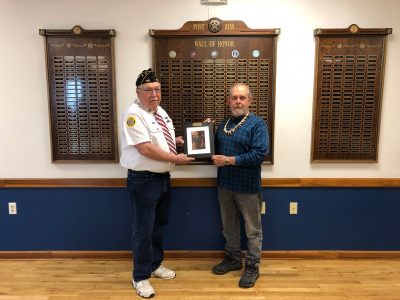
ST. CLAIRSVILLE -- Larry Jones said he was honored to be selected as the St. Clairsville American Legion Veteran of the Month and to have served his country.
Jones served in the U.S. Army from 1965-67 as a Specialist 4; his military occupational specialty was O5B20 -- a radio operator. He was born in Lamira and has lived in St. Clairsville since 1970.
"I was assigned to the 1st Cavalry Division, and that's the greatest fighting unit in the Vietnam War," he said. "I was assigned to the 2nd Battalion, 20th Aerial Rocket Artillery."
He was in a helicopter unit.
"We had 24 rocket pods on each side of the helicopter, and we flew direct support for the airborne brigade of the 1st Cavalry Division. We were situated in An Khe, Vietnam, and the 1st Cavalry was in charge of the ... area."
Jones' duties included support for the 1st and 2nd dividision of the 8th Cavalry, the 1st and 2nd of the 12th Cavalry, and sometimes the 1st of the 9th Cavalry and portions of the recon unit.
"When they'd get hit, get pinned down, whatever, take small arms fire, they would call in to battalion headquarters for artillery support," he said. "We would fly over the area of where they were, and we would fire the rockets into where the fire support was asked for by coordinates. You had to get coordinates right, and you had to get the area right. ... Me and three other guys, our job was to be the relay station. ... We would have to take a generator and our radio, both of them, and fly into the area where the infantry was. They would set us on the ground, we'd set up our radios, and we would call the aircraft in and be the relay in case radio communication was bad, and that's what we did every day.
"It was a series of regular operations," he said, adding flights were a daily activity. He said while the job could be challenging, he admired the infantry soldiers.
"Those guys on the ground ... the regular infantrymen, they had it rough," he said. "Myself, I was very, very fortunate. I got to fly ... a big difference right there."
He was often under fire.
"They would mortar us. The Viet Cong would send in anything from four to six mortars at a time from a village or wherever they could get set up to hide. They would usually shoot them in a horseshoe manner because they could move the mortar quickly. Then they would tear down and run."
Jones said the politics of the conflict was often a source of frustration.
"The United States was playing fair. They would be set up in a village. ... We weren't allowed to shoot, because we would kill civilians. They didn't care. They killed anybody they wanted to, and that's the way it was fought in '65 and '66. We played fair. They played to win. We could have beat them any point in time," he said.
"You kill 500 to 700 Viet Cong, body count, what do you do? You just run them into Cambodia. We pulled back, and they came right back in, and we did that constantly. We'd shove them out of an area, pull back, they came right back in."
Jones said he took pride in helping keep the 2nd Battalion air mobile.
"When a call came in that one of the infantry units got hit, we could go from laying on your cot on Sunday afternoon to in the helicopter, in the air with all of your equipment, loaded rocket pods, in 20 minutes," he said. "We were air mobile. We thrived on that."
He recalled one incident in 1966 when he said his superiors tried to bait out the enemy.
"They sent us out, the two helicopters and the people from the Special Forces camp as bait. You set the bait out there, and maybe they'll hit you, and back behind you was all the artillery and the rest of the helicopters and everything to annihilate them, and that's the kind of thing you did," he said. "You said, 'What in the world? Why am I out here?' Nighttime comes, you know what we had for protection, two strings of concertina wire. ... We were there for three days. They never hit us."
He said there was little in the way of compensation.
"My pay as an E-4: $168.60 a month, and I had an $80 car payment," he said. "I got hazardous duty pay and I got flight pay for a little bit. I lost the flight pay when I got malaria and I was in the hospital."
After 45 days of hospitalization and recovery he was placed on guard duty.
He concluded his service in Fort Hamilton, New York.
Jones noted the war was a controversial one.
"When I rotated back to the States ... we got into a cab to the airport in San Francisco to fly back to Ohio. There were some protesters around. I happened to get there, it was 10, 11 p.m. so there were only two or three," he said. "They did some hissing and stuff like that, but I took it in stride."
He said many memories persist.
"The worst thing I did, and it was tough -- the helicopters would fly the wounded in when somebody got hit," he said. "We had to carry the litters with wounded American boys on them. Bullets have no conscience. They hit where they want when you're in battle. It's not like the movies. It's real," he said.
In civilian life, Jones worked as a construction worker and cement mason.