
St. Clairsville ends seven-month reliance on county water
Trending
ST. CLAIRSVILLE -- For the first time in 2026, the city of St. Clairsville is no longer relying on Belmont County for its water supply.
Since December 2025, the city has been purchasing water from Belmont County after one of the filters at its water treatment plant failed.
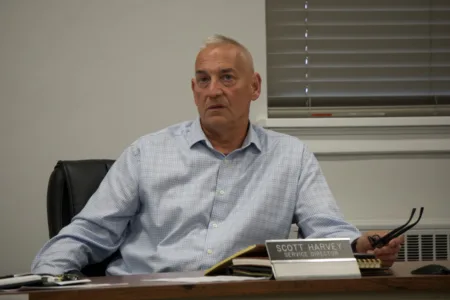
Service Director Scott Harvey announced during Monday’s City Council meeting that the city’s water treatment plant has returned to full operation.
"We had to take it offline, which limited us to about two-thirds production. There’s three filters at the plant. The one that was an issue has finally been repaired, and it’s back," Harvey said. "We’re back up to full operation down there now. So we’re producing all our own water again, and we’re not relying on the county."
Harvey said the city relied heavily on county water while the filter was out of service.
"Usually, our plant production is around 550,000 to 600,000 gallons a month. We’ve been operating at two-thirds capacity basically for that period of time," Harvey said. "We’ve been blending county water with what we can produce out of the two that were operational."
He said the city had been purchasing approximately $25,000 worth of water from the county each month, totaling about $175,000 during the outage.
Harvey said the city will soon begin its routine hydrant flushing now that the treatment plant has returned to full capacity.
"We do that typically two to three times a year, but with the water plant being at its capacity, we’ve waited for that. So we’ll start flushing hydrants in the next couple weeks," Harvey said. "You’ll see crews out flushing and we’ll get notifications out through CodeRED and on our website, so if you have low pressure or maybe discoloration, it could be from the hydrant flushing that’s coming up."
Harvey also told council the water department is conducting smoke testing in Ward 2.
Smoke testing is a method used to identify leaks and defects in the sanitary sewer system. Smoke should not enter homes unless there is a defect in the home’s plumbing system or drain traps have dried out.
Harvey said the testing helps identify issues within both the city’s sewer system and private connections.
"It’s not that we’re just trying to find homeowner issues but issues that we have within the city too. So we try to find those problems and fix them," Harvey said. "And it’s just more realistic to do it ward by ward. If you try to do the whole city at once, it becomes too much of a list, and things get lost and missed. So when we focus on a ward, it keeps everything moving better."
Harvey also addressed recent complaints from residents about discolored water.
He said the issue commonly occurs during periods of extreme heat because the city’s water comes from a surface water source.
"It’s usually this time of year, but when the weather gets as hot as it has been, we get complaints of discolored water, and what that basically comes down to is because we are a surface water treatment plant. If you have a farm pond, when it gets hot like this, they do what they call a flip over. The pond flips over, and when the reservoir basically flips over all of the algae and everything flips. It causes the turbidity, so we have to up our chemical treatment to fight the algae off," Harvey said.
According to the U.S. Geological Survey, turbidity is a measure of the clarity of water and the amount of light scattered by particles suspended in it. Higher levels of scattered light indicate higher turbidity.
"When we put that chemical treatment to it, it just puts a color to the water. So we experience it every year that I’ve been here, and I’ve been here for 12 years, and every year we have the same problem," Harvey said. "It’s usually when it hits 95 to 100 degrees for a few days in a row. But that problem seems to have gone away as the temperature has changed a little bit. We got a lot of rain, which seemed to help things."
Harvey emphasized the water remains safe to drink and use.
He compared the temporary discoloration to adding Kool-Aid to a glass of water.
"It just gives it a color. So it is concerning when you’re looking at it, you’re like, 'Is this safe?' It is, but it’s just not really pleasing to look at," Harvey said.