Monroe County hosts forum on drug addiction
Monroe County hosts forum on drug epidemic
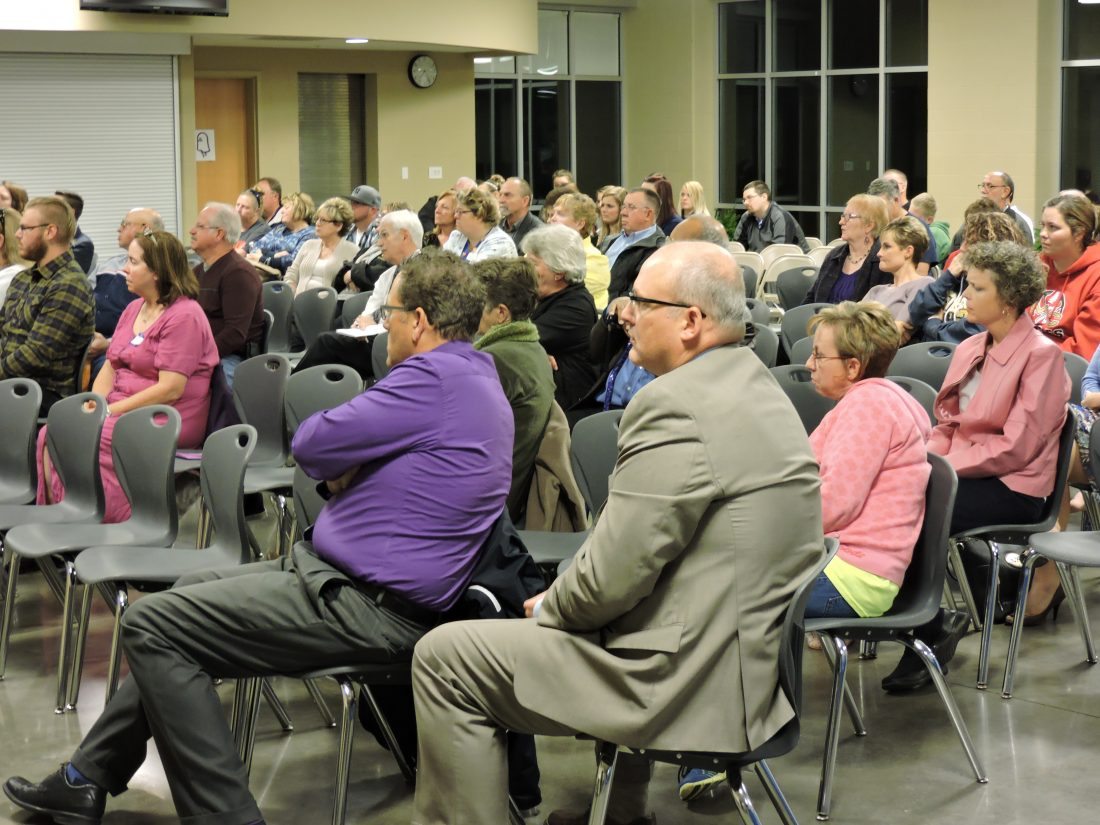
About 120 Monroe County residents attend at town hall meeting on drug abuse in Woodsfield on Tuesday.
T-L Photos/JANELL HUNTER
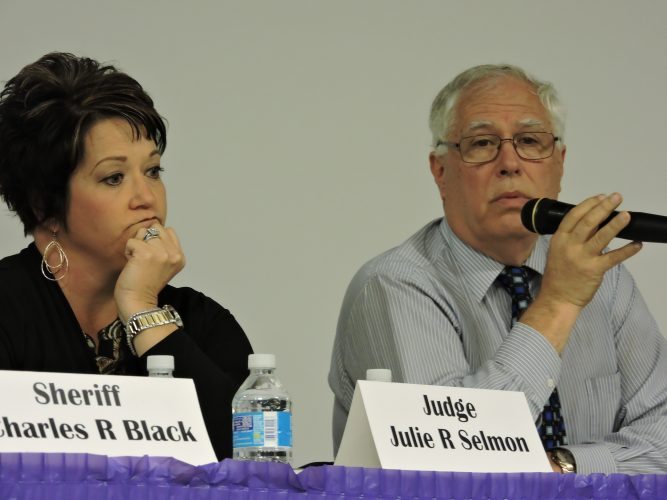
Monroe County Common Pleas Judge Julie R. Selmon and County Judge Clifford N. Sickler share their perspectives on how the opioid epidemic is affecting the local community.
WOODSFIELD — Monroe County is serious about the need to address and combat opioid addiction and the many problems that go along with it.
Local law enforcement, politicians, health care professionals and anti-drug organizations came together to host a town hall meeting at Monroe Central High School on Tuesday to raise awareness of the problem of heroin addiction in the community.
A panel of eight people familiar with the epidemic in different ways brought “local faces, local stories and local experience” to shed light on the subject. Each panel member took time to present his or her perspective to an audience of about 120 people, and took a number of questions at the end of the program.
The event, titled “Heroin Hits Home: A Local Epidemic,” was moderated by Monroe County Commissioner Mick Schumacher. It was the third program in a series sponsored by Barnesville Hospital, Ohio Hills Health Services and Crossroads Counseling Services, as well as many other sponsors and community partners.
The goals of the event were to educate parents and the community on signs and symptoms of opioid abuse and treatment options, to outline legal implications of abuse, to increase awareness of medically assisted treatment options, and to eliminate the stigma of admitting addiction and getting help.
“We need to rehumanize this epidemic. We have reached a point where it has become easy to be apathetic, easy to say we can’t do anything. But we can. … Every day, there are messages of hope,” said Carol Baden of Ohio Attorney General Mike DeWine’s office.
Baden said she is working in Columbus to increase the need for long-term treatment and support through new programs that help people begin treatment as soon as possible. She called on the business community to be part of the solution, and for communities to host “sober” activities and events.
“The stigma still exists, but we are seeing a decrease in the stigma,” she said.
Monroe County Sheriff Charles Black said he has seen death and destruction from opioid abuse on a “routine” basis. He noted when he began working in law enforcement in the 1990s, all he had to deal with was alcohol and marijuana.
He emphasized that opioid addiction is much worse, and that it can affect anyone, regardless of upbringing, religion and socioeconomic status.
Monroe County Common Pleas Judge Julie R. Selmon said that in her 11 years on the bench, she has seen a tremendous increase in the number of ancillary offenses such as theft that come from drug addiction.
“These people are breaking into places, stealing from friends and family to keep up their drug habit. … When we see these people in court, it is almost too late for them. We don’t see many successful cases. It is an uphill battle. We will do everything we can to help these folks, but we need to keep the public safe,” said Selmon.
Monroe County Judge Cliff Sickler said there are sometimes few options beyond imprisonment.
“Dealers are more dangerous than the abuser. They do not care what the consequences are. … We need to be very wise and introspective as to what we’re going to do as a community. I never had to worry about anything like this as a kid,” said Sickler.
Dr. Russell Lee-Wood of Barnesville Hospital said he has worked with hundreds of patients on medically assisted treatment of opioid addiction with Suboxone, and will be starting treatments with Vivitrol. Lee-Wood said there is a much higher rate of success in treating the addiction with medication and therapy.
“No one person is treated the same. There is no one-size-fits-all answer. You must change your life. … There is a spiritual aspect. We need to ask, who are you? Are you going to take your life back? … The patient has to want to do it. It is not a magic cure. You must make them accountable and don’t coddle them,” said Lee-Wood.
Carmen Rhodes spoke as a mother of an addict. She said when her son finally wanted help for his heroin addiction, she had trouble finding it. She tearfully told the audience about her son’s struggles — his trips to rehab and his relapses. She explained the need for long term rehabilitation facilities to be located in the area.
“I hate that drug. Heroin is awful. You young people — don’t even do it one time. … My son didn’t intend on being a drug addict,” Rhodes said.
Jessica Hoff, a recovering heroin addict, shared her experience as one of struggle in addiction and hope in recovery. She spoke about a drug treatment program in California that helped teach her how to be herself and to be “OK with it.”
“I was lucky that my parents were who they were, because I got support from the community. Other people don’t have that. I think it’s important that we all understand what this is and who it affects, that it can be anybody. Other people are going to need our support. And they need to know that when they come back and aren’t well yet, that this community supports them and aren’t still holding on to who they were last year,” Hoff said.
Tim Kraft, director of the Dream Life Christian counseling organization of Parkersburg, was the last panel member to speak. A former heroin addict, he told the audience about finding freedom in sobriety and that medically assisted therapy never helped him.
“I was a 12-year opiate addict. … I tried Suboxone, and once that cycle ended, I went right back to heroin … so for me, personally, it never worked because here’s what I realized over time: I was never created to be dependent on a substance. It was never my intended purpose to be dependent on a substance for my peace, my happiness, my joy. It was never the intention of my life. So when I found freedom, I got delivered … ,” said Kraft.
Dream Life is a one-year program that is free of charge, funded by donations.
“God always provides,” said Kraft.
Local News

Double amputee who fled Belmont County authorities now in custody
JVS students go to jail, but for educational purposes

St. Clairsville launches girls flag football team, remains unbeaten

Hopping into Easter at the Ohio Valley Mall

2 U.S. fighter jets shot down in Iran