Mineral owners hear predictions about future of natural gas
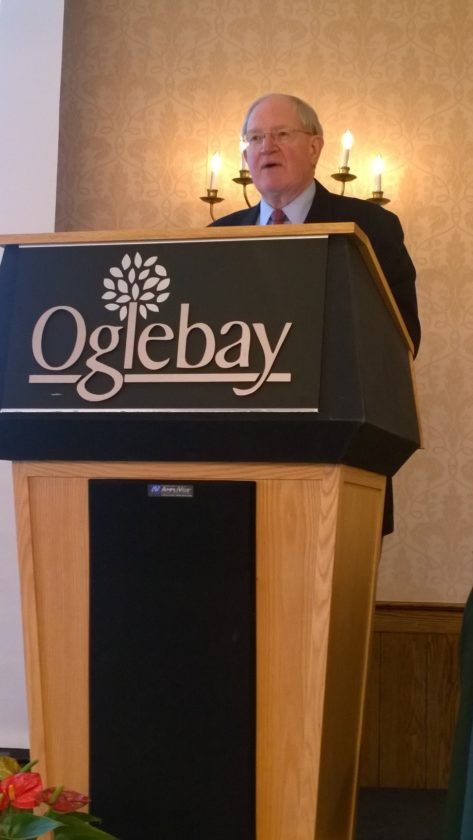
T-L Photo/JENNIFER COMPSTON-STROUGH Jim Halloran, an independent energy analyst, speaks Tuesday to people attending the National Association of Royalty Owners’ 2018 Appalachian Conference. He estimated that natural gas prices will remain static until 2022 as infrastructure projects are completed and demand remains level.
WHEELING — Predicting the future of the natural gas industry is a bit like following Alice through the looking-glass, according to an independent energy analyst, but he believes the story will become easier to read by 2022.
Jim Halloran, who holds degrees in business and accounting, spoke Tuesday to those attending the National Association of Royalty Owners’ 2018 Appalachian Conference. His topic was “The Future of the Natural Gas Market,” and he outlined a number of factors that will help determine the course of the industry over time. Among those, he said, are four “perceptions” that are having and impact regardless of whether the are accurate. They include:
∫ We have a 100-year supply of cheap natural gas.
∫ Climate change needs action.
∫ Nuclear and coal power are losing to the competition (renewables and natural gas).
∫ There is an increasing global energy market.
According to Halloran, the United States’ natural gas reserves are not as large as many people believe — at least not in terms of reserves that can be accessed at current market rates. Halloran said natural gas prices are now “artificially” low at about $3 per 1,000 cubic feet after reaching a high of $14 in 2008. That means production costs must remain low enough for companies to continue turning profits while still selling gas at such rates. Once the “sweet spots” that are highly productive have all been tapped, production costs will increase and either prices will rise or production will decline.
Halloran cited other factors he said are interfering with natural gas development, especially in the local region. Demand for electricity is declining, he said, and government regulations are slowing market growth.
He also noted, however, that there are a number of things working in favor of expanding the industry. For example, subsurface risks associated with exploration and production are declining as technology for locating underground resources improves.
“There’s no such thing as a dry hole anymore,” he stressed.
Halloran said we are now in the “age of infrastructure” — a period he defined as stretching from 2018-2022 — meaning that the pipelines for transporting natural gas and related products, as well as the facilities to process those resources, are being built right now. He estimated that major pipeline construction will continue in the region for about three more years. He added that the number of conventional wells and their production are declining, putting more emphasis on the hydraulic fracturing and horizontal drilling techniques being used in Ohio, West Virginia and Pennsylvania in the Marcellus Shale and Utica Shale fields.
“The Utica and Marcellus are key to the future of natural gas,” he noted.
Halloran also predicted that demand for gas will increase as the use of coal and nuclear sources of power decline. He said the nation will need a back-up plan in support of using more renewable energy sources, and he said he believes natural gas will fill that role.
Locally, he said, the large amount of ethane found in the natural gas reserves beneath our feet is actually a negative at this point in the shale play. He explained that much of the ethane is simply being shipped out with the natural gas, or methane, stream, because our region lacks the cracker facilities required to process the ethane so it can be used in industries such as plastics manufacturing. Ultimately, he said that problem is leading to an oversupply of propane, which keeps prices low. He believes, though, that the problem likely will solve itself.
Halloran pointed to the ethane cracker plant currently under construction in Monaca, Pennsylvania, and said he believes similar plants will follow. In particular, he said he has high hopes that PTT Global Chemical will build a cracker plant at Dilles Bottom in Belmont County.
Joe Eddy, president and CEO of Eagle Manufacturing and executive vice president of Just Right Safety Group, agreed when he spoke on behalf of the Marietta-based organization Shale Crescent USA. He said Eagle uses plastic pellets and that having access to manufacturers in the local area would make a big difference for his business.
Eddy holds a degree in chemical engineering and has a long history of working in the business, beginning on drilling rigs in Ohio in 1979.
“We are in the middle of the largest oil and gas boom in our country’s history,” Eddy said, noting that more than $100 billion already has been invested in developing oil and gas interests in the Appalachian basin.
Eddy added that he hopes PTT will announce its plans to build the Dilles Bottom cracker by late October. He said organizations such as Shale Crescent USA are working to make sure that other, related businesses will follow.
“Literally, we are marketing this region to the world,” he said.
In addition to hearing from Halloran and Eddy, conference attendees heard updates on changes to mineral rights laws in Ohio and West Virginia. They also had the opportunity to attend a wide variety of sessions and to talk with several vendors throughout the event, which began Sunday and concluded Tuesday at Wilson Lodge at Oglebay Park.
Local News

JVS students go to jail, but for educational purposes

St. Clairsville launches girls flag football team, remains unbeaten

Hopping into Easter at the Ohio Valley Mall

2 U.S. fighter jets shot down in Iran

Sinclair Foundation donates thousands to Bellaire Library