
Kinney appeals murder case
Trending
ST. CLAIRSVILLE -- The man convicted of murdering Brad McGarry, 43, at his Bellaire home in May of 2017, is challenging his sentence of life without parole.
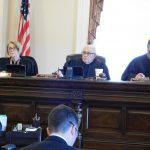
David Carl Kinney, 32, of Brilliant, was sentenced February of 2018 by Belmont County Common Pleas Judge Frank Fregiato. On Wednesday, the case was argued before Seventh District Court of Appeals Judges Carol Ann Robb, Gene Donofrio, and David D'Apolito. The judges heard from Kinney's attorney, Chris Gagin, and from Belmont County Chief Assistant Prosecutor Kevin Flanagan. Flanagan said afterward that the court may return a decision in two months.
Kinney was found guilty after an eight-day trial. Kinney, who was married, was apparently romantically involved with McGarry. Kinney originally had reported finding McGarry's body during a visit to the Bellaire home accompanied by his wife and daughter on May 7. Suspicion fell on him during an interview May 9 with Belmont County Sheriff's Chief Detective Ryan Allar, in which Kinney gave several contradictory stories. He finally admitted he had shot McGarry but claimed he did so in self-defense when McGarry produced a gun, which Kinney said was fatally fired in the course of a struggle.
According to documents from the Belmont County Clerk of Court's office, Gagin is demanding a new trial for Kinney.
Before the appeals court, Gagin argued that there were several problematic issues with the case, including an inability to prove prior calculation and design. He also said police overstepped their power during the interrogation. Additionally, Gagin challenged the practice of imposing life without parole.
"The central issue that I think the court is going need to first address is the video (interrogation)," Gagin said, adding that while the questioning began as a voluntary interview, there were points where he had reason to believe he had he was in custody. "I ask the court as it reviews this video -- and it's a remarkable video. You've never seen a six-foot-six, 300-pound man sob as hard as you will see in this video."
While Gagin said Kinney made untrue statements before admitting to shooting McGarry, he said the forensic evidence does not match Kinney's description of standing over McGarry and shooting him.
"The forensic evidence is irrefutable," he said, adding that the reported distance from which Kinney indicated he shot was too far to create a circular pattern of soot on McGarry's head. Gagin also said that Kinney should have been read his Miranda rights immediately after saying he shot McGarry.
D'Apolito asked for clarification, asking if Kinney was maintaining the act was self-defense.
"He's explaining why he did this, out of a self-defense act?"
"That's correct. … He never actually confessed to murder," Gagin said, adding that this was still the correct time to have read Kinney his rights.
Gagin also said the potential of law enforcement to release information about Kinney's reported affair with McGarry was coercive.
"I have a client … who is sitting with life without parole for an offense I don't believe he's guilty of," Gagin said. "The court needs to define the limits of interrogative power and coercion."
Gagin also challenged a recording of a conversation between Kinney and his wife after the interrogation. Gagin also said one of the jurors had convictions against same-sex marriage, but indicated an ability to put this aside and follow the evidence.
Flanagan disagreed that the forensic evidence could objectively rule out the shooting as Kinney described it. He referred to a forensic pathologist who testified during the trial.
"It is impossible to duplicate or re-create a gunshot trajectory," Flanagan said. "Although there was forensic evidence, it was anything but objective, at least coming from the defense side."
Regarding the interrogation, Flanagan described the interaction as cordial.
"(Gagin) has brought up a valid point," Robb said. "There comes a time when he makes an admission that he shot the victim, and at that point in time he was not administered his rights. At that point in time, it could be reasonably determined that he was not free to leave."
"The video speaks for itself," Flanagan said, adding that law enforcement followed case law. "He wasn't necessarily confessing to a crime. It was more self-serving."
Regarding the recorded conversation between Kinney and his wife, Flanagan said Kinney could not have expected privacy in a public place, and in any case there was no new information gained from the recording.
Flanagan also commented on Kinney's case.
"The defendant's story, from the very beginning, simply did not make sense. It did not pass muster," Flanagan said, adding that Kinney had planned to visit McGarry the day of the murder, and to bring his family. He said the defense claimed Kinney had visited McGarry beforehand, there was a fight and Kinney killed McGarry in self-defense.
"Yet (Kinney) chose this time … to tell his lover (McGarry) … that he was going to break up with him and he would choose his wife over his lover. … I don't think the jury bought that," Flanagan said. "He was now going to bring … his wife in front of the jilted lover?"
Gagin said Kinney had hoped to remain friends with McGarry.
"If this is a staged, planned murder, it was the worst staged, planned murder in the history of Ohio," Gagin said. "David Kinney, on a beautiful Sunday afternoon simply drove to his friend's house with the intent … of putting two bullets in the back of his head, and then concocting the worst story in the history of the world? That makes no sense."