Ferry leaders outline need for added income tax
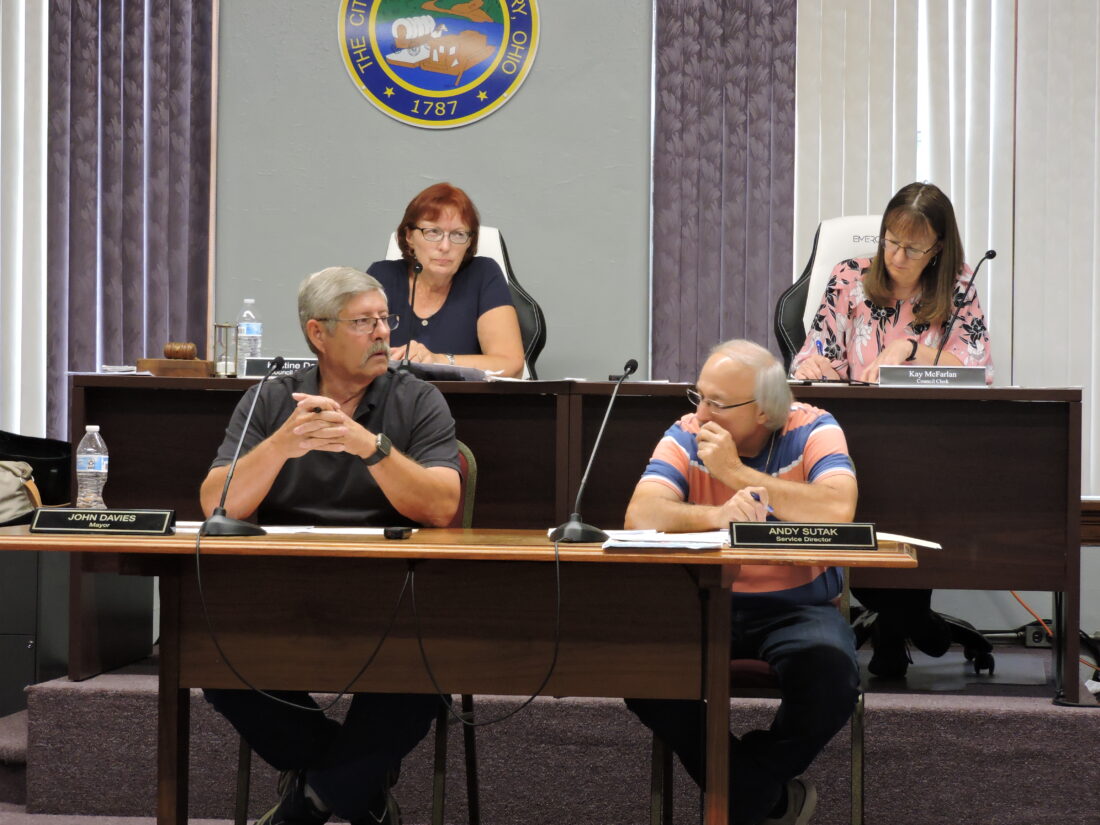
T-L File Photo/KAILEY CARPINO President of Martins Ferry City Council Kristine Davis, top left, Mayor John Davies, front left, Service Director Andy Sutak and Clerk of Council Kay McFarlan participate in discussion of proposed income tax changes.
Editor’s note: Martins Ferry City Council placed a 1% income tax increase on the Nov. 7 ballot. This is the first of two articles on that subject. The following outlines city leaders’ reasons for asking voters to approve the tax hike. On Monday, another article will highlight potential uses for the additional revenue.
MARTINS FERRY — Inflation, crime and other factors are driving the need to increase income tax revenue in the Purple City.
Martins Ferry City Council members and the administration sat down with The Times Leader on Wednesday to stress the importance of the proposed income tax increase and to seek voters’ support. The city has a 1 percent income tax in place, and residents will vote in the Nov. 7 general election on whether to increase the income tax to 2 percent.
People who live in the city must pay the income tax unless they work in another municipality where they are required to pay an income tax. People who work in Martins Ferry but live elsewhere are required to pay the income tax to the city.
Councilwoman Suzanne Armstrong said the city needs the additional income tax revenue because the amount of state and county funding allotted to it has declined. Armstrong also said the city lost needed revenue when East Ohio Regional Hospital closed and lost more revenue by providing tax incentives when it reopened.
President of Council Kristine Davis echoed that the closure of the hospital had a negative impact on city coffers.
“The hospital went out of business in 2019 and between September of 2019 and July of 2021, we got no income from them. So we went through a period where we lost a mass of income. That put us a little behind. Everything has piled on and piled on,” Davis said.
Davis also noted that the decline in state funding over the past year has hurt the city.
“The local government money went from 3.68% to 1.66%. The state used to allow 3.68% of their state income for local government funds, then it went to 1.66%, with a little adjustment in between there. Frankly, I don’t think we get our fair share of it,” she said.
Davis added that the COVID-19 pandemic, recession, inflation and crime are the main factors in council’s decision to place the income tax increase on the ballot.
“Crime has its costs. We have seen increased crime in the valley, which is increased police hours, which has increased police overtime. All this is general fund, and that’s where our problem is,” she said.
Armstrong said that according to U.S. Census information, the number of residents in Martins Ferry recently declined, meaning that fewer people are paying city taxes.
The bureau estimated the population at 6,257 in April 2020 with a decline of 1.9% to 6,140 residents by July 2022. The population stood at 6,915 in 2010 and was slightly more than 8,000 in 1990. Historic records state the population had reached nearly 15,000 – or more than triple the current number of residents – in 1940.
Armstrong and Councilman James Schramm agreed that inflation is one of the main reasons the city wants to increase the income tax.
“Over the years, inflation in this country has gone up considerably and we have not raised anything in the city in years, our utilities or anything else. As inflation increases, we’re just getting further behind what we need to collect, so my feeling is we need (the tax increase). I don’t want to pay it either, but we need it,” Schramm said. “We’re so far behind. If this continues on for another two years without raising it above 1 percent, we will be so far behind and will never catch up.”
Armstrong said the city has been facing these issues for several years.
“This all could have happened earlier than 2023. When we suffered the COVID epidemic, what happened was the city ended up getting rescue money, which more or less delayed what we’re facing right now,” she said.
Councilman Tom Burns said the demographics of the city have changed drastically over the years.
“The taxpayer base has declined dramatically,” he noted, referring to the city’s once-thriving industrial base.
Burns agreed with Armstrong and Schramm on reasons to increase the income tax.
“We’ve had inflationary costs, everything’s going up. Anything that has to do with oil, like paving or anything else, has been going up at an astronomical rate. Wages go up. We’re not getting the oil and gas money we used to get. Our infrastructure repairs, we’re so far behind on those. We don’t have the businesses in town, the large businesses to pay taxes anymore like we used to, and we’ve lost a lot of that,” Burns said.
Armstrong said that property taxes could decrease if the income tax increase passes. She explained that the two levies currently in place – one for funding the police department and one for funding the EMS department – could be canceled. Council would have to pass an ordinance to lower the property tax.
City leaders will host a town hall meeting at 6 p.m. Oct. 16 at the Martins Ferry Recreation Center to further discuss the proposed income tax increase with the public. The meeting will be held upstairs at the facility.
Auditor Jack Regis estimates that if the income tax increase passes, it would generate about $1.6 million in additional revenue for the city each year.
Local News

Trump defends Iran war, offers few new details in address

Monroe Co. school bus driver surprised with 90th birthday celebration

The Health Plan to sponsor Bethlehem Apostolic Temple Easter food distribution
Belmont DJFS discusses its work during Child Abuse Prevention Month

Artemis II astronauts bound for moon