Paleo-Indians, prehistoric tools and wildlife discussed at museum
BARNESVILLE — John Boilegh spoke about the Paleo-Indians, prehistoric tools and wildlife Monday night at the Belmont County Victorian Mansion Museum in Barnesville.
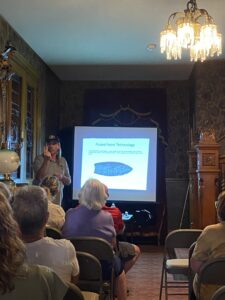
Boilegh presented “The First Ohions: Life at the End of the Ice Age” to a room of audience members interested in archaeology. He drew attention from the audience by using a slideshow for a visual presentation and showing prehistoric items and tools.
Boilegh discussed the Paleo-Indian population, specifically in Ohio, and taught attendees the Paleo-Indian population is identifiable in archaeological records because of fluted point technology. It is an early stone tool technique the Paleo-Indians used for creating projectile points, such as a spear tip.
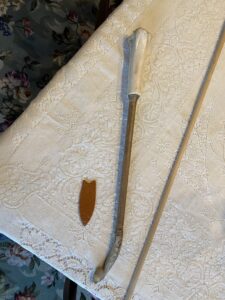
Prehistoric tools used for hunting were shown during the presentation including a spear and Folsom and Clovis points as projectile points put onto the spear tips.
Boilegh emphasized the Clovis points can’t be found to be used in any other time frame and were specific to the end of the ice age. More are found on the East Coast rather than the West, he said.
Scientists believe the flute, a groove in the tool, actually strengthened the piece of stone, which is why the people used it, Boilegh said.
Boilegh said the people had a rich material culture, in that for every stone tool archaeologists find, they think that there are 20 other tools made of different material.
With these tools came hunting wildlife. The Paleo-Indians hunted animals such as the mastodon, an animal native to North America that is smaller than a mammoth.
Dead mastodon remains are found with stone tool butchering marks on them, which is how we know the Paleo people hunted these animals.
A lot of the animals here now in Ohio were here 13,000 years ago as well, Boilegh said. But there are also a lot of animals that are not here anymore, including caribou and wolverines.
The stag-moose, giant beaver and short-faced bear were all animals from the end of the ice age as well.
Following an hour-long presentation, Boilegh answered attendees’ questions. Questions about snakes in Ohio and why fewer turtles have been crossing the road recently were asked.
To wrap up, attendees were encouraged to bring any prehistoric items of their own for Boilegh to examine. People brought items including a celt, a tool for wood-working made of stone, a stone bowl for grinding and a cup stone.
Boilegh believed a couple of these items to possibly not be prehistoric but still interesting to see, he said.
Boilegh said people have an innate love of history but don’t realize it, and it’s fascinating to look back thousands of years to see how people lived. He noted prehistoric people had the same minds as modern humans, just not the same technology.
“I think it’s really important in that people have that interest, and I think sometimes there is a lot of misinformation that seems to be going around a lot,” he said. “So there’s a lot of things that people can pick up and learn and take with them.”
Local News

Sinclair Foundation donates thousands to Bellaire Library

Belmont County bomb threat suspect’s case moved to Common Pleas Court

Two arrested in Brooke County on child neglect charges after 1-month-old’s death
Ohio Dems push affordability legislation; critics tout consequences
Ohio House Democrats House recently unveiled a series of legislative proposals on a major issue in this year’s ...

Artemis II’s moonbound toilet working again to astronauts’ relief