Eclipse creates celestial sensation in Ohio
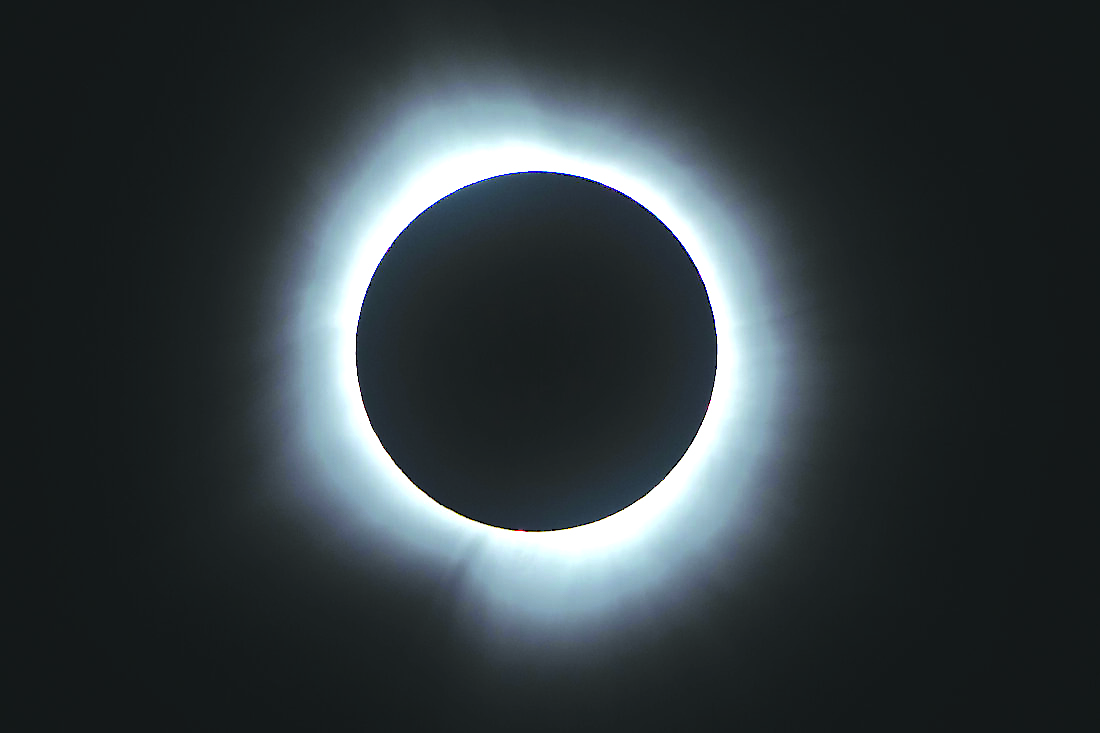
The moon covers the sun during a total solar eclipse at the Indianapolis Motor Speedway in Indianapolis, Monday, April 8, 2024. AP File Photo
FOR 4 minutes and 28 seconds on April 8, the moon blotted out the sun over a large swath of North America, providing a celestial spectacle for skywatchers to enjoy.
The path of totality swept across Ohio from the Dayton area in the west to Lake Erie in the east. Gov. Mike DeWine declared an emergency in advance of the total solar eclipse, anticipating that large numbers of visitors would disrupt traffic and business across the Buckeye State.
Indeed, hotels and campgrounds in the areas where the sun would be completely blocked by the moon sold out.
Large community celebrations were held, and people of all ages and from all walks of life turned their eyes skyward to take it in.
For weeks prior to the arrival of the eclipse, news outlets warned of the dangers of viewing an eclipse with the naked eye. Many manufacturers sold special eclipse viewing glasses.
Other sources provided different kinds of tools to increase safety while viewing, while some savvy spectators created viewing devices of their own using pin holes poked in paper or cardboard. For those using cameras, telescopes or binoculars, special filters were available to make viewing safe.
According to the Associated Press, full solar eclipses occur every year or two or three, but often in places such as the South Pacific or Antarctic. The next total solar eclipse, in 2026, will grace the northern fringes of Greenland, Iceland and Spain.
North America won’t experience totality again until 2033, with Alaska getting sole dibs. Then that’s it until 2044, when totality will be confined to Western Canada, Montana and North Dakota.
There won’t be another U.S. eclipse, spanning coast to coast, until 2045. That one will stretch from Northern California all the way to Cape Canaveral, Florida.
Local residents put on their protective eclipse glasses to view what was an impressive partial eclipse in the Upper Ohio Valley.
Although Belmont County wasn’t in the path of totality, the eclipse could be seen with up to 97% coverage.
Local News

Sinclair Foundation donates thousands to Bellaire Library

Belmont County bomb threat suspect’s case moved to Common Pleas Court

Two arrested in Brooke County on child neglect charges after 1-month-old’s death
Ohio Dems push affordability legislation; critics tout consequences
Ohio House Democrats House recently unveiled a series of legislative proposals on a major issue in this year’s ...
Artemis II’s moonbound toilet working again to astronauts’ relief