
Federal EPA confirms no ‘forever chemicals’ in St. C.
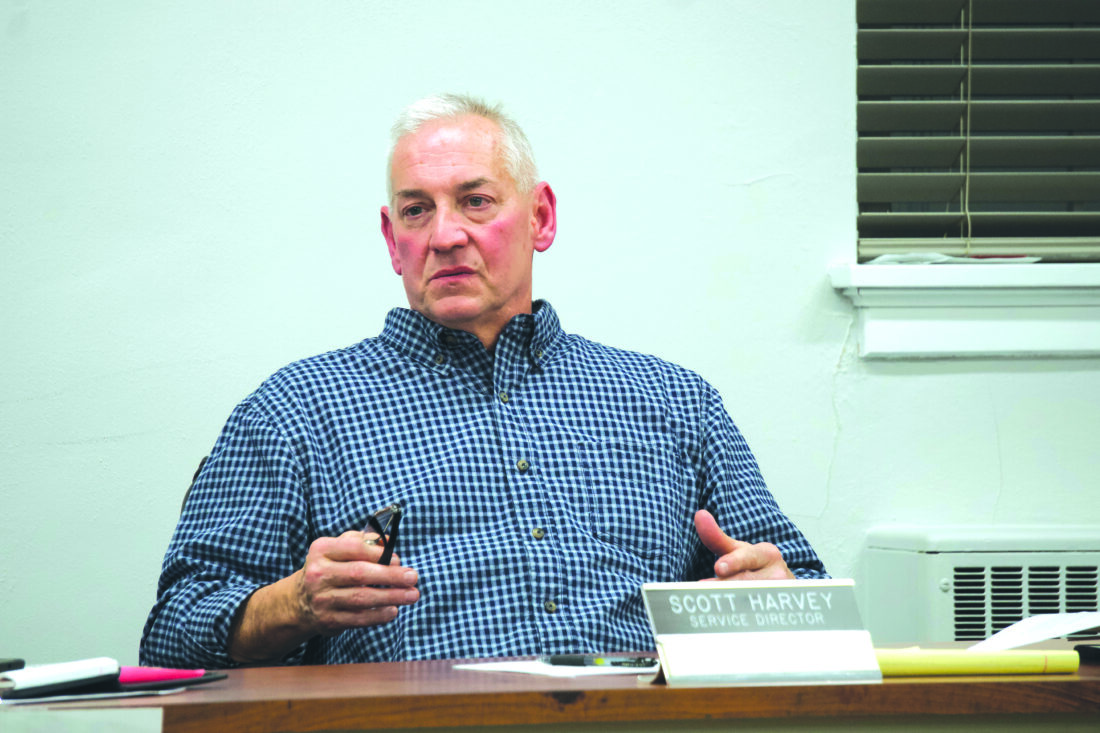
St. Clairsville service director Scott Harvey provides council with an update on Perfluoroalkyl and Polyfluoroalkyl substance levels that the Federal EPA conducted on St. Clairsville’s water sources.
-
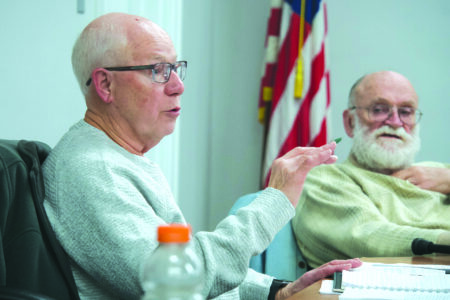
- St. Clairsville city council member Mike Kasper makes a motion to become a liaison between the city and St. Clairsville-Richland City School District board as council member Lucien Murzyn sits on right.
ST. CLAIRSVILLE — Recently, the federal Environmental Protection Agency tested St. Clairsville’s water for Perfluoroalkyl and Polyfluoroalkyl substance levels.
During service director Scott Harvey’s regular report during Tuesday evening’s city council meeting he informed council that the EPA found zero evidence of Perfluoroalkyl and Polyfluoroalkyl substance in the city’s water sources.
This first test is the first of many through 2026 that will continue testing for “forever chemicals.”
“The federal EPA’s tech committee is tackling emerging contaminants and they basically set up a system where we don’t have to pay for the testing, which is expensive,” Harvey said. “So they have people come in, do the testing, take the samples and test it, and then they send us the results as they go along. We just got our first results back which showed no detection of PFAS. So we’re very encouraged with that.”
He added that the main reservoir — Provident — and the city’s water treatment plant were all tested without any indication.
“What that means to us is our water is safe first of all, but it also means that we don’t have to change our treatment because if it is detected then you have to change the treatment of how it comes through your water treatment plan which is expensive, so no detection is good news for us,” Harvey said.
According to the EPA’s website, studies in laboratory animals indicate some PFAS can cause reproductive, developmental, liver, kidney and immunological toxicity. In addition, exposure to some PFAS produces tumors in laboratory animals.
In humans, the most consistent findings from epidemiology studies are increased cholesterol levels among exposed populations with more limited findings related to infant birth weights, effects on the immune system, cancer and thyroid hormone disruption. Some PFAS can cause adverse effects on the respiratory system following acute inhalation exposures.
Harvey said that the EPA will be conducting regular studies on the city’s water sources for the next year but he believes there is no indication that PFAS will be found.
“They test monthly and they go to those three testing places and test then provide us with a report,” he said. “They come back a little slow on reports, but we just got our first one back and we’re pretty encouraged with the good findings.”
He added that the EPA does not test the city water towers because it isn’t the city’s water that’s in question — it’s the integrity of the water.
“It’s the source of water that they’re checking. So in other words, if our main reservoir was being fed by a contaminant, it would show up there before it got to our water treatment plant. So that’s what they’re looking for,” Harvey said. “Then, if there is a contaminant there, they trace it back to where it came from, and then they help mitigate it.”
He added that he is confident that the city will continue to receive glowing reports.
In other matters, council member Mike Kasper made a motion to become a liaison for council to attend St. Clairsville-Richland City School District board meetings and provide council updates about the meetings.
“I would like to start attending the school board meetings and bring back a report to council on what’s going on at the school,” he said. “The school and the city need work hand in hand. I think we do very well, but I want to keep the communications open.”
Council agreed that his idea is a good one and unanimously passed his motion.
Local News

Virginia man arraigned on murder charge connected to Jan. 15 shooting in Bellaire
Johnston sentenced to 10 years after fifth felony OVI
Two Franciscan students found dead in parked car
STEUBENVILLE — The two Franciscan University of Steubenville students whose bodies were found outside a residence ...
Federal EPA confirms no ‘forever chemicals’ in St. C.

Coroner: Franciscan University Students Died From Carbon Monoxide Poisoning
