Martins Ferry drops paid parking, converts downtown to free two-hour parking
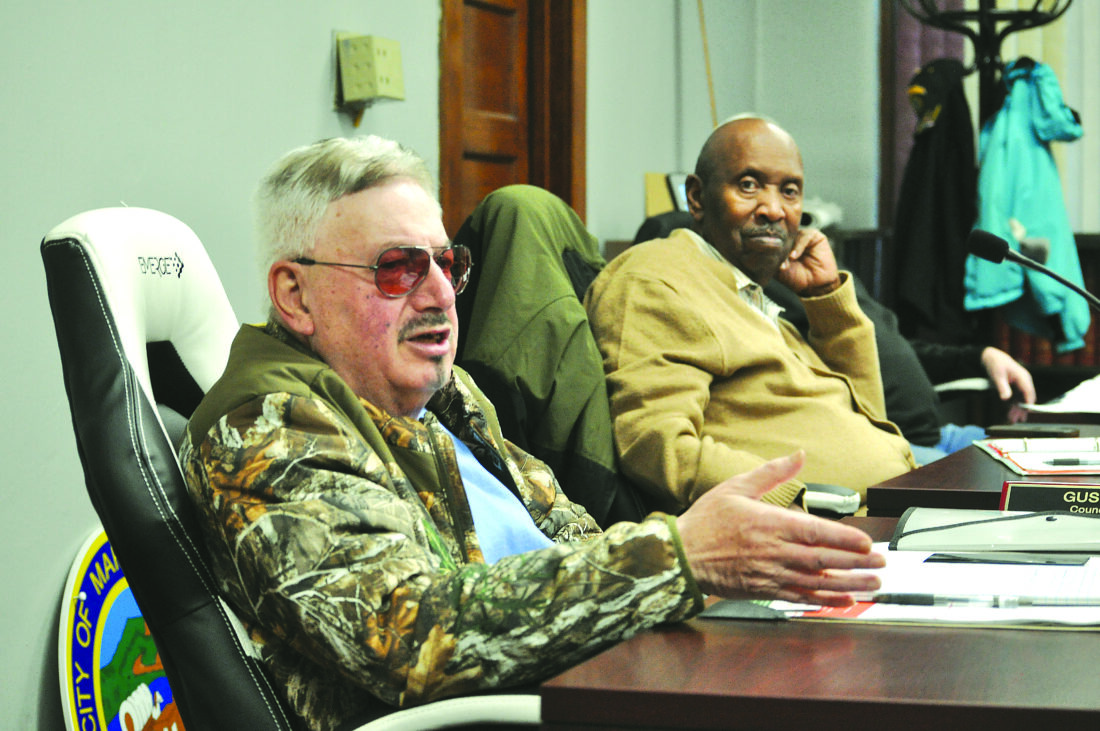
Photo by STEPHANIE ELVERD Martins Ferry councilman Gus Harris discusses downtown parking with city safety director Melissa Yeso while fellow councilman Rev. James Agnew listens during Wednesday’s council meeting.
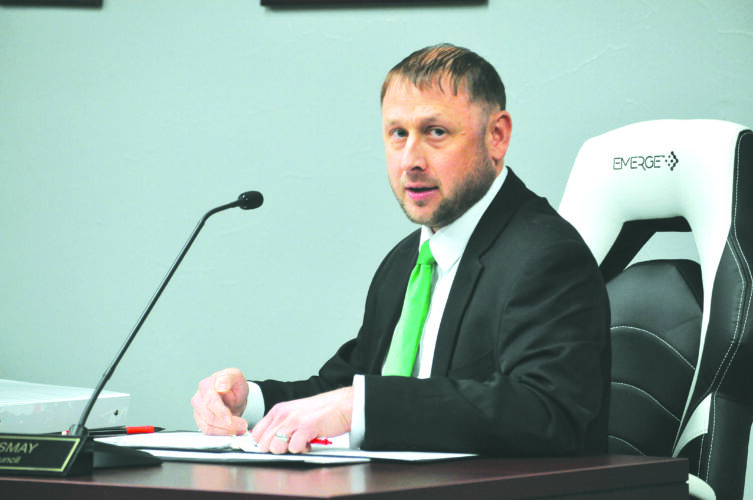
Photo by STEPHANIE ELVERD
Martins Ferry councilman Andrew Smay asks a question during Wednesday’s council meeting.
MARTINS FERRY — With plans to implement a meterless parking program within the city now scrapped, Martins Ferry Safety Director Melissa Yeso told council on Wednesday, parking in the downtown business district will soon be free.
“We are moving away from paid parking, period,” Yeso said during Wednesday’s council meeting.
The move comes following pushback from residents against the meterless parking that was to replace coin meters using the ParkMobile app.
A special city council meeting was held last November where council voted in favor of implementing meterless parking which would have required parking fees to be paid at a pay station that accepted both cash and credit cards or via an app.
The idea was presented to council by Police Chief Vincent West who said the new system would generate more funds for the city than the current parking meters due to his department being so short-staffed. But the idea was met with both criticism and skepticism, and the village eventually abandoned the plan.
“We made the decision, since there were concerns and people weren’t ready yet to go into the electronic age, we will be converting all the meters on a slow basis to two-hour customer parking only and we are hoping to start that process in the spring,” Yeso explained. “This will help alleviate the tenants that live in town that use our downtown as their driveway and it creates an opportunity for our customers to have business front parking.”
As the parking meters come out, signs informing visitors of the two-hour parking limit will go in. The placards will be placed throughout the city. The police can still ticket for parking violation if it is determined a vehicle had been parked in a spot past the time allotted. The police will utilize a chalking method — marking behind the front and back tires — and other methods to make that determination.
Those who work in the business district will be held to the same set of rules. Yeso said the city is reaching out to business owners and employees to make them aware of the pending parking changes and available remedies.
“Any employee that works in the city or works at any of the city villages, we will be conveying that there are spaces available for rent in any of our permanent parking spaces and we will encourage employers to make arrangements for their employees that way,” she said.
Yeso also discussed a recent complaint brought to council about the condition of a house within the city and the stray cats that live in and around the home. She said the human society has agreed to spay and neuter the strays and an animal rescue has agreed to rehome all of the cats once they are sterilized. She also said she has been in communication with the owners of the property in question and they have begun to clean up and repair the property.
“The first conversation will always be nice. We made arrangements to have [the residents clean up the exterior of their house,” Yeso said. “I drove by yesterday and they’ve actually done a very nice job so far, but we take the attitude that ‘your problem should not be your surrounding neighbor’s problem.'”
Yeso said two other city properties — since identified as rentals – were also looked at. The landlords of both have since been contacted to address the situation.
“We will no longer tolerate the excessive trash kept around the homes,” Yeso said. “It’s a breeding ground for cats, raccoons and rats and we can’t have that in city limits.”
Another problem property – which has fallen onto its neighboring lots on Clinton Street – will also be addressed. Yeso said that the owner of that vacant home — whose last-known address was St. Clairsville — owes $20,000 in delinquent property taxes.
“We are going to make every effort to try to contact the owner of that property to let them know the situation,” Yeso said. “But the reality is if they owe $20,000 in back taxes they most likely don’t have an interest in maintaining the property or helping their neighbor.”
The proactive approach to addressing problem priorities is part of “moving the city” forward, Yeso said.
“Change is inevitable,” she said. “If we don’t like change, we will like irrelevance a whole lot less.”
Local News
Ohio Supreme Court issues updated guide for child custody issues
(The Center Square) — It’s not every day state Supreme courts dispense parenting advice, but the Ohio Supreme ...
Martins Ferry drops paid parking, converts downtown to free two-hour parking
Sen. Brian Chavez has high energy hopes for Ohio
Tressel visits Marietta to discuss WorkOhio launch
MARIETTA — Ohio Lieutenant Governor Jim Tressel visited the Lafayette Hotel, one of two stops on Wednesday, to ...

Virginia man arraigned on murder charge connected to Jan. 15 shooting in Bellaire