Hope Scholarship reform bill still being worked on
Hope Scholarship reform bill still being worked on
CHARLESTON – House Finance Committee leaders said they are still receiving input before unveiling an updated version of its originating bill reforming the Hope Scholarship, while Hope funding received a focus as the state Senate passed its budget Friday.
The House Finance Committee met Friday morning and recommended several bills for passage to the House of Delegates. But the final bill on its agenda, the mark-up and discussion phase for a yet-to-be-numbered originating bill making changes to the Hope Scholarship educational voucher program, was not taken up.
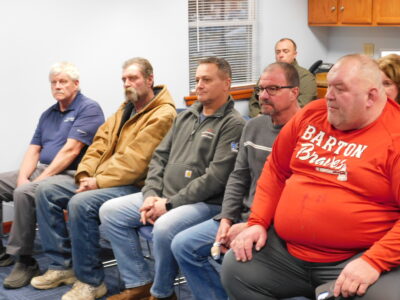
More than a dozen private and home school families receiving the Hope Scholarship were in attendance for Friday’s committee meeting, with some coming from more than three hours away. Some expressed their anger as they exited the committee room.
House Finance Committee Chairman Vernon Criss and Vice Chairman Clay Riley said the bill was pulled from consideration Friday because the committee is still receiving public comment and input from caucus members and other stakeholders. They expect to take up a committee substitute for the bill soon.
“There’s a lot of public interest, and sometimes, (when) the right information is not out there, it causes concern,” Criss said. “One of the things that we’re trying to do here is bring in line the things that we want to provide through Hope Scholarship so in the long term that the program can survive.”
“It’s very common for agendas to be fluid,” Riley said. “One of the things in the process that we have in the House is we have a committee hearing, so that we can get the information out there. We can get feedback from committee members. We can get feedback from the rest of our colleagues in the House. We can get feedback from the 1.8 million citizens of the state of West Virginia, and that’s really important.”
The committee held a hearing Wednesday on an originating bill that would cap the annual Hope Scholarship award to eligible families at $5,250, with the $250 going to the State Treasurer’s Office for its administrative costs for overseeing the program. It also changes the payout schedule for the program from twice per fiscal year to four times.
“We want to make sure that we’re responsible in the way that we pay for this … because the payment program is very difficult for us,” Criss said. “Now that we’ve opened it up to the entire student population for the State of West Virginia, we’re not sure how many dollars are going to be needed come August.”
The Hope Scholarship gives parents the option to use an equivalent portion of the per-pupil expenditure from the state School Aid Formula ($5,690 for the upcoming 2026-27 school year) for their children for educational expenses, such as private or religious school tuition, home school, tutoring and learning aids. Money comes from the general revenue fund.
Under the originating bill, Hope funds could only be used for tuition and fees at participating in-state private schools, ongoing services provided by a public school district, tuition and fees for programs of study or curriculum that lead to industry-recognized workforce credentials, tuition and fees for in-state microschools, certain educational therapy services, home school curriculum and fees for transportation paid to and from participating in-state private schools.
“We want to make sure that if it’s available in public school – curriculum and technology and the opportunity to do that – that it’s going to be available for you to get and get paid for in the private school sector or in the homeschooling sector,” Criss said.
The originating bill requires parents signing their Hope Scholarship agreement to be in compliance with required assessments of student performance and allows Hope funds to be used for standardized testing fees. It also requires annual confirmation that Hope Scholarship students who have an individualized instructional program have taken the comprehensive statewide student growth assessment.
Opposition to the House Finance originating bill has been vocal despite a minority of students in the state participating in the program, which up to now has only been open to children who are eligible to be enrolled in a county school system’s kindergarten program the year the parents are applying, public school students who were enrolled full time during the school year prior to applying for the scholarship or public school students enrolled for at least 45 days during the current school year.
Next fiscal year, the Hope Scholarship expands to all West Virginia children regardless of enrollment status. The application window for new students to receive the 100% award for the 2026-27 school year opens March 2 and closes June 15.
Over in the state Senate Friday afternoon, debate on Senate Bill 250 – the general revenue budget legislation for fiscal year 2027 beginning on July 1 – focused on the Hope Scholarship and how it is funded.
SB 250 passed the Senate Friday in a 28-4 vote with two members absent or not voting. The Senate’s FY27 general revenue budget proposal was $5.381 billion, a 2% decrease from the $5.493 billion budget presented to lawmakers by Gov. Patrick Morrisey at the beginning of the session. Major changes include lowering the price tag of the Hope Scholarship educational voucher program from the governor’s recommended $338.3 million (including $230 million for FY27) to $300 million.
Instead of funding the bulk of the Hope Scholarship program through the general revenue fund,
the Senate proposal funds $100 million from supplemental appropriations of available general revenue, lottery and excess lottery funds, and $200 million to be paid out from available surplus tax collections at the end of the current fiscal year June 30.
“The Hope Scholarship is pre-funded faster than ever before,” said Senate Finance Committee Chairman Jason Barrett, R-Berkeley. “That means that the money to Hope to ensure the solvency of the Hope Scholarship will be there … This combined with the $200 million found in the general revenue section of this bill will fully fund Hope Scholarship for (fiscal year) 2027 and the first half of fiscal year 2028 – the first time … that we have ever done that.
Both Senate Minority Leader Mike Woelfel and Senate Assistant Minority Leader Joey Garcia voted against the budget bill, in part over concerns about the ballooning cost of the Hope program.
“I never thought I’d see the day where the West Virginia Senate is going to boast that it is allocating $300 million to school vouchers,” said Woelfel, D-Cabell. “Our school boards are barely hanging on. Public education is the constitutional right to our children. So, I’m a no vote on this. I think our priorities are mixed up.”
“Most of our children do not use Hope. Most of our children are in counties where schools are consolidating,” said Garcia, D-Marion. “One of the things that was promised with the Hope Scholarship was that everybody would have a chance and a choice. But if you look at how much it costs to go to a private school now, that price has increased. The Hope Scholarship has stayed the same.”
Senate Assistant Majority Leader Patricia Rucker, who also chairs the Senate’s Select Committee on School Choice, has come out in opposition of the House Finance originating bill on the Hope Scholarship. Speaking on the Senate floor Friday, Rucker thanked the Senate Finance Committee for ensuring Hope stays fully funded.
“There are some who keep trying to set up the Hope Scholarship as a boogeyman of some sort, a program that is set up to ensure that every child in West Virginia gets a good education,” said Rucker, R-Jefferson. “At the end of the day, it is my hope to support a budget that we pass that is going to completely fund the Hope Scholarship and all of the necessary programs for the citizens of this state.”
Local News
Hope Scholarship reform bill still being worked on
CHARLESTON – House Finance Committee leaders said they are still receiving input before unveiling an updated ...
Area fire departments receive ODNR grants
COLUMBUS — Several area fire departments will share in more than $593,000 in grant money from the Ohio Department ...
Ex-retirement board members banned from serving
An Ohio judge ruled that two former members of the State Teachers’ Retirement System board participated in “a ...
‘Moose’ of a donation
City Reaffirms Free Two-Hour Parking, No Reserved Street Spaces for Businesses