
Mazeroski remembered for both his ability and his humility
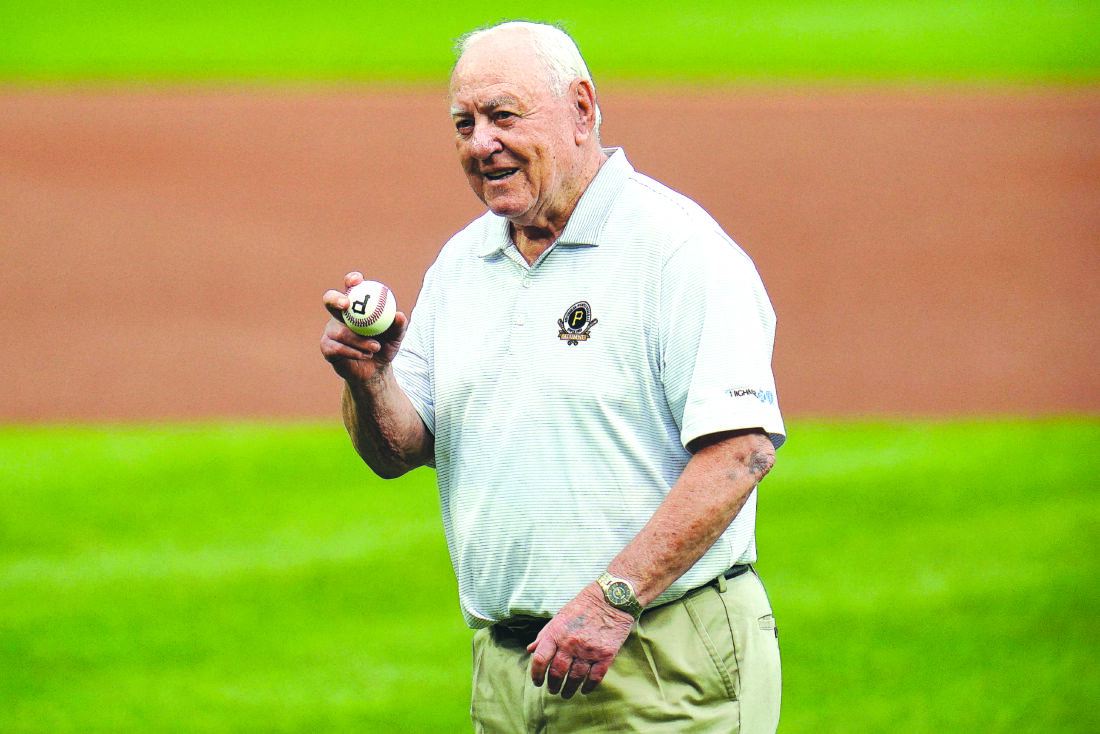
FILE - Pittsburgh Pirates Baseball Hall of Fame second baseman Bill Mazeroski prepares to throw out a ceremonial first pitch before a baseball game between the Pittsburgh Pirates and the New York Yankees in Pittsburgh, Tuesday, July 5, 2022. (AP Photo/Gene J. Puskar, File)
WHEELING — Bill Mazeroski, a baseball legend of both the Pittsburgh Pirates and the Ohio Valley, died Friday evening at 89.
Mazeroski, who was immortalized with his walk-off home run in Game 7 of the 1960 World Series, was remembered just as fondly for his humility, class and sense of humor by those who knew him from his time growing up near Tiltonsville, and from the many trips back to the Ohio Valley that the eight-time Gold Glover took after his playing days.
“Anyone would tell you he was one of the most humble gentlemen that you’d ever known and one of the kindest men that you’d ever know,” Bridgeport Superintendent Brent Ripley said.
“I was fortunate, I was blessed to play in some golf tournaments with him away from here over toward Greensburg,” Don Cash, a board member in the Bridgeport Exempted Village School District, said. “I was at his home. Talking to him, you would’ve never known that Bill Mazeroski was a Hall of Fame player. He was just a Hall of Fame individual, he was the salt of the earth, he made you feel comfortable. I was just kind of in awe of him.”
Mazeroski made a lasting impression on most everyone who got to know him– and a lasting impression on Ohio Valley sports history, where his escapades have become the stuff of legend.
“My good friend Phil Niekro, a special baseball player, was pitching, he was undefeated,” Bridgeport businessman Gordie Longshaw said. “Mazeroski was playing for his high school team, Warren Consolidated, which is the Buckeye Local school district today.”
“Whoever wins this game advances to Columbus for the state tournament. Mazeroski hit a home run off of Phil Niekro and they were able to go to the state tournament, 1-0. Maz pitched the game in the morning and won a game against Toledo. The afternoon game against Cincinnati, they lost, and he pitched that game too, which you can’t do in high school anymore. He was a great athlete.”
Longshaw, a contemporary of Mazeroski’s growing up, really got to know the Hall of Famer on a trip down to the Pittsburgh Pirates’ “Fantasy Camp” in Florida 25 years ago, and stayed in touch ever since.
“For 25 years, Gordie Longshaw, Brian Schambach, and I put on the Phil Niekro Golf Classic that benefited our schools,” Cash said. “And Bill and Phil and Elroy Face, and John Havlicek and Joe Niekro all would come to the golf tournament year after year after year, especially later on, Bill and Elroy came forever. Every year they came, and we always had a Friday night event and we would sit down and have a few adult beverages and sit around and talk and laugh and he’d tell stories — but he never talked about baseball.
“He talked about everything else. I was a 41-year basketball official, and every time I saw Bill, he’d say, Don, how’s Buckeye Local’s team this year? And I’d tell him, good or bad, whatever they were at the time.”
While Mazeroski resided in Greensburg, Pennsylvania, in his later years, his old stomping grounds were never far from his mind.
“Yes, he did come back and was proud to come back,” Longshaw said. “In 1979, they honored him at the Dapper Dan dinner at WesBanco Arena, him, Phil and Joe Niekro, who are all in the OVAC Hall of Fame in Wheeling. He was never afraid to come back. He was proud of it.”
“He never forgot where he came from,” Cash said.
Buckeye Local’s baseball field was named after Mazeroski in 2003. A statue of Mazeroski was built just outside PNC Park in 2010. And the all-time record holder for double-plays turned (1,706) was not shy about making memories for anybody who approached him.
“Maz would come to our golf tournament and he would sign everything,” Cash said. “You walked up, ‘Can you sign a baseball? Can you sign a picture?’ He did it without hesitation, loved doing it. But like I said, beyond the fact that everybody knew who he was, if you didn’t know who he was, you would’ve thought he’s just another guy. And that’s probably his best attribute.”
“Super, super guy,” Longshaw said. “I got his jacket for the Hall of Fame induction at Cooperstown and he gave me his baseball glove and bat from high school.”
Born in Wheeling, Mazeroski lived for a time in a one-room home with no electricity or indoor plumbing. Longshaw said his nickname in high school was ‘Catfish,’ because Mazeroski would often be seen along the Ohio River on the hunt for catfish.
“That’s why he got the name Catfish, because he was always going down there catching fish to have dinner. I mean, that’s how poor he was,” Longshaw said.
As one would expect from a fellow baseball legend from the Ohio Valley, Steubenville native and World Series winning coach Rich Donnelly was quite familiar with Mazeroski or indeed as he first knew him, Catfish.
“I heard about him very early, when I was little,” Donnelly said. “When I was eight or nine, I heard about this kid at Tiltonsville High School named Catfish Mazeroski. He was a basketball player, and everybody in the valley knew who he was.
“My brother, Romi Donnelly, was a pitcher. He ended up going to Notre Dame and playing minor league ball. He played against Maz in the summer leagues. My brother would tell me, ‘You’ve got to see this kid play second base; he’s unbelievably quick. His hands are quick; his feet are quick.’ I asked what his name was and he said Bill Mazeroski. And I went, ‘Wait a minute, Catfish?’ That’s what everybody called him in the paper when he had a good basketball game for Tiltonsville, was Catfish.
“I got a little older, and then all of a sudden, this Catfish, Bill Mazeroski, turns out to be playing for my favorite team, the Buccos. I was the A-plus student in Pirate history; I kept the box score of almost every game he ever played. I followed him all the way through. I used to go to Forbes Field and see him. I was absolutely amazed at how quickly he turned a double play. And then, of course, the most famous part was 1960, when he hit the home run to win the World Series, which was like the highlight of a young kid’s life. He was entrenched in Pirate history forever.”
As it turned out, Donnelly’s own career would later connect him with the Pirate legend who grew up 10 minutes down the river. While some might tell you never to meet your heroes, Donnelly meeting one of his is something he’s cherished forever.
“Who knew that some 20-some years later, I’d be working as a coach for the Pirates in 1986, and I’d be working with none other than Bill Mazeroski,” Donnelly said. “I thought, ‘Are you kidding me? I get to work with him?’ He was one of the coaches at spring training and every morning, I got to have coffee and sit with him and Bill Virdon, one of my other heroes.
“Maz was the greatest. He was so humble. You would have never thought he’d hit a home run in his life or won any Golden Gloves or anything like that; he was so humble and so quiet. And I just admired the way he carried himself, and I’m just so blessed that I got to know him and I got to work with him.
“I tell people this all the time, in my career, my baseball cards came to life. I played baseball cards with Bill Mazeroski’s baseball card, and years later, I’m sitting there every morning having coffee with him at a meeting and he’s telling me stories about guys on the team I grew up watching.”
In Donnelly’s eyes, Mazeroski’s legacy will live on for a long, long time. Mazeroski’s induction into the Hall of Fame for his defensive prowess is a lasting testament to how he impacted baseball forever.
“I think if you talk to people, when you mention the Pirates, I think probably the first guy they would mention would be Clemente, and then in the same breath, they would mention Maz’s home run and mention Maz,” Donnelly said. “And the fact that he was the first defensive player to be elected to the Hall of Fame, and rightly so, I think because of the way he played, he changed the perception of people, of voters in the Hall of Fame. You could be a great defensive player, you don’t have to hit 45 home runs every year anything like that, but you could be a really good defensive player and be an All-Star, have notoriety, and be in the Hall of Fame.
“I know this, he was so proud of that, that he set the precedent later for people recognizing that defense is a very big part of baseball.”
As someone who grew up pretending to be like Mazeroski while hitting rocks in the alley or playing whiffle ball with his friends and was inspired by a fellow local kid making it big, Donnelly counts Mazeroski’s impact on baseball in the Ohio Valley as immeasurable.
“Young kids now, of course, they weren’t even born, but they know about that home run,” Donnelly said of Max’s Game 7 winner. “And I think what it shows, the kids in the Ohio Valley, that while he wasn’t the fastest, he wasn’t the biggest, he was a true baseball player that just worked hard and made it, not only to the big leagues, but became an All-Star and ultimately a Hall of Famer. He was just a normal Valley guy. He was just a normal kid; he came from a steel mill working family like most of us did. He was one of us. And when I say that, I think that’s the biggest thing, that he was one of us.
“He gave everybody in this Valley, every kid, hope that you can make it. And you don’t have to be a superstar to do it, but you can do it with being a good teammate, being a hard worker, and having the persistence to stay in there and do it. And that’s exactly what he did.
“He exemplified the Valley. He played on those fields in Wheeling, on Rush Run, in Tiltonsville, in Dillonville and in Yorkville. The same fields we played on. And he made it to the big leagues. He was an All-Star. So, it gave hope to anybody, any kid in this valley who had dreams to maybe someday be a big league player or a college player or whatever. He didn’t come from California. He didn’t come from Texas. He didn’t come from Florida. He didn’t play for a great college team at all. Nothing like that. He was just one of us — a sandlot player that played on the same fields that we did in the Ohio Valley.
“He influenced a generation of kids to get to their goal of either being a high school player, a college player, or a pro player. And everybody back then, they wanted to be like Maz. He influenced a whole generation of kids who played baseball in the Valley.”
Mazeroski is survived by two sons, David and Darren, and four grandchildren.
Local News
Mazeroski remembered for both his ability and his humility
Justice Department files antitrust lawsuit against OhioHealth
(The Center Square) — The Trump administration and Ohio Attorney General Dave Yost sued one of Ohio’s largest ...
Viewing the Spectrum of Progress in the valley
The future of the Ohio Valley is the responsibility of everyone who lives here, not just the most familiar names. ...
Nelly & Dash teaching ways of the past to the present
Baseball Hall of Famer ‘Maz’ dies at 89
More than a home: The Healing Mission of Abba’s Heart
At just 5 years old, Benson, a young boy from Kenya, wandered the streets alone, searching for food in garbage ...