
Next Generation 911 is successfully implemented in Belmont County
Trending
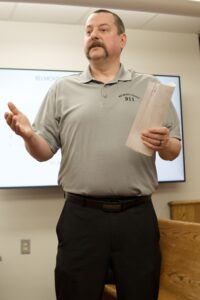
ST. CLAIRSVILLE - Belmont County 911 Director Bryan Minder informed the Belmont County Board of Commissioners that his department recently converted to Next Generation 911 — a digital, internet-protocol-based system that will replace the analog 911 infrastructure that's been in place for decades.
"On March 3, we went ahead and we went over to the new system that’s run by a company called Comtech that’s contracted with the state of Ohio to do the Next Generation 911, we were the 15th county in Ohio to do it. Initially last year, there were 10 pilot counties that did it, and then we opted into it after that," Minder said. "Every county in Ohio has five years to transition over to the new Next Gen system."
He added that Belmont, Harrison, Jefferson, and Monroe counties have all successfully switched over and are all online right now. Noble and Guernsey counties are in the process of switching over but have not yet.
Minder said that the system gives a digital circuitry to how 911 calls come in. The old system Belmont County 911 used was an analog system with copper phone lines.
"It’s an all digital, IP based system now at this time. And so what that does, it gives not only better location accuracy for callers, we can see where they are better. It will allow the system to put and transfer the call to the correct 911 center a lot easier, especially with somewhere like us along the lines of the border, with West Virginia, things like that," Minder said. "It’s going to help to eliminate not all, but some of the transfers that happen because transfers take time. Transfers are a delay when you’re calling for help, and you’ve got to be transferred at least one, sometimes two times."
He added that the new system is a huge benefit to everybody involved.
"It also gives us the capabilities of not only just voice to 911, but now text to 911 is now a capability in the county," Minder said. "It allows somebody who can’t speak, for whatever reason, they can now contact 911 still just by texting 911 on their phone."
He still recommends calling instead of texting unless it is not possible to call. Minder said that calling is significantly better to call than text because his department can receive much more information from a call than a text.
"We ask people to call if you can, but text if you can’t. We get so much more information from somebody calling in and hearing what’s going on in the background, hearing their voice and just picking up a lot more as a dispatcher that way, versus texting back and forth, so that’s one of the big benefits of it," Minder said.
Although it was implemented on March 3, Minder said it was still too early to determine if the system has worked better than the analog system that was previously used.
"It’s hard to compare, we just don’t have enough information yet to say if it’s gotten better or not as far as seeing how many transfers we’ve gotten or have had to transfer out," Minder said. "Until we get a few months worth of data in, it’s going to be hard to see the benefit right away. But it is working well, it’s a good system, and we’re happy that it’s up and running."
He added that he's relieved that the process of switching to Next Generation 911 is complete.
“It’s been a long year, there's just so many little things you have to get in place before they can even consider coming," Minder said. "It’s a lot of work."