Belmont DJFS discusses its work during Child Abuse Prevention Month
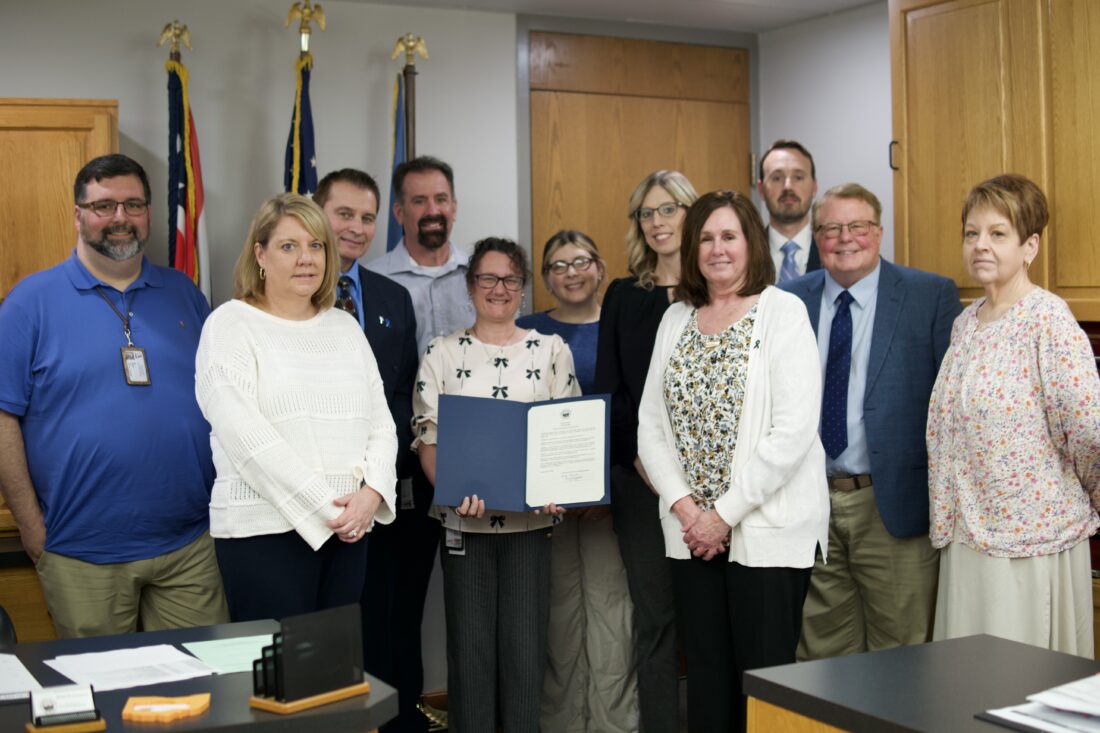
Belmont County Department of Job and Family Services Foster Care Caseworkers Ed Braun, from left, Nicole Couch, Belmont County commissioner Vince Gianangeli, caseworkers Jeff Edwards, Aubrey Erbach, Emily Cominsky, Jessica Cruse, administrator Christine Parker commissioner J.P. Dutton, Jerry Echemann, and Connect to Family program specialist Hope Romshak celebrate April being declared Child Abuse Prevention Month.
ST. CLAIRSVILLE – April was declared Child Abuse Prevention Month in Belmont County by the county’s board of commissioners Wednesday morning.
Belmont County Department of Job and Family Services Director Jeff Felton and Administrator Christine Parker spoke to the board about what the department has achieved in the last year as well as what it plans to achieve in the coming year.
Parker says that, in 2025, the DJFS received 1,450 calls and conducted 454 investigations.
“That’s pretty much right on target for what we usually do. The average number of children we have in custody at any one time was 59 children. Most of the children that we have in custody are in our foster homes. We do very well recruiting and keeping foster homes, thanks to [Job and Family Services Foster Care Caseworker Ed Braun], he has a really good relationship with those families,” Parker said. “We have approximately 40 homes right now, and the children that are not in our foster homes, most of them are in kinship placements.”
She added that the DJFS also has a Connect to Family program which is for when a child comes into custody, she gives the case to Connect to Family program specialist Hope Romshak who begins looking for kinship placements and support people for the child.
Parker said that Romshak has one of the highest placement rates in Ohio.
“When she gets a case, she finds a home for that child. Because placing the child in a kinship home is better than a foster home,” Parker said.
In addition to the 42 foster homes, the department has started a new initiative called the Treatment Foster Home program.
“We have two homes that are officially with us,one in the works, and possibly another one. We’re starting another program called Ohio Start, and that is for families that become involved with us due to having substance use disorders. And what that’s going to be is we’re going to have a worker, a peer mentor person who is in recovery, and maybe had some services involvement also, and that worker will go out with an assigned start worker and do visits together with the family,” Parker said. “The other counties in Ohio who’ve done this program report really good results; over 50 counties do it already and we’ll be starting that soon.”
Felton added that another program the department will be implementing is the Fatherhood Initiative.
“The Department of Children and Youth put out a grant application for engaging fathers, the Fatherhood Initiative. We considered applying, and then we met with Forever Dad’s Executive Director [Ryan Sheppard] who’s been doing this in Muskingum County and surrounding counties, and wanted to know if we would support their application, and Christine [Parker] and I were very, very happy to do so,” Felton said. “That means we didn’t have to write the grant. And they have a lot of experience in these programs. It’s really a focus on engaging fathers in general. They work a lot with prisons and jails, engaging fathers with their children. They work with Children’s Services.
“Oftentimes, as a man, I say, ‘Where’s the dad?’ If we remove the child from the mother, we tend to reunify with the mother,” he added. “And dads may or may not be involved. We’re hopeful, we have a staff meeting coming up, and they’re going to present to the staff how their programming services can assist us in our child welfare cases, as well as engaging fathers in general.”
He added that he is excited to focus on fathers.
Belmont County Commissioner Jerry Echemann asked Felton if, when looking into kinship placement where the child will go to grandparents, they notice the grandparents not being up to it.
“Do you find it difficult to make the judgment whether grandma and grandpa have enough energy in the tank to handle a toddler or a 5-year-old?” Echemann asked.
Felton replied that when thinking of grandparents most people think of someone that is 70 years old or older but that’s not always the case.
“I’ve been doing this for almost 30 years and when I first started, grandma and grandpa were like 65 and 70 years old. Grandma and Grandpa these days could be 35 or 40 years old. So many times they have more energy than traditionally thought of grandparents like myself, I’m a grandparent,” Felton said.
“But we give them support in terms of respite care. We don’t want to over stress them, because there’s enough stress in their lives.”
He added that if the grandparents say they aren’t able to handle care for the children, it is still recommended that somebody else actually be the placement for the child.
Felton added that even if the grandparents aren’t able to fully take care of the children he tries to make it to where the children regularly visit the grandparents.
Local News

Trump defends Iran war, offers few new details in address
Monroe Co. school bus driver surprised with 90th birthday celebration
The Health Plan to sponsor Bethlehem Apostolic Temple Easter food distribution
Belmont DJFS discusses its work during Child Abuse Prevention Month

Artemis II astronauts bound for moon