
Bridging the gap: Rails toTrails group sees opportunity in Market Street Bridge
Trending
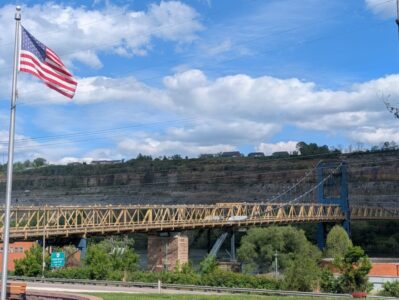
STEUBENVILLE -- While most people look at the old Market Street Bridge in terms of what it used to be, the Rails to Trails Conservancy is focused on what it can be.
The RTC, a nonprofit working to transform abandoned rail corridors across the country into recreation spaces, will be pedaling into the Ohio Valley in September, bringing a "by invitation only" group of power brokers with them.
"Elected officials, agency staff -- the kind of people who should feel the trail to be able to make decisions and talk about it," said Kevin Belle, project director of the Great American Rail Trail at Rails to Trails Conservancy.
Belle said the group will ride the trail between Pittsburgh and Columbus, "shuttling through some of the gaps."
Their goal, he said, is to "raise awareness and get people to experience it, get them talking about it in a way that highlights economic development possibilities, tourism possibilities, outdoor recreation and public health."
"Jefferson County is a really important piece, as well as the sections in West Virginia, because we know how important the crossing of the Ohio River is for the Market Street Bridge, the redevelopment that's happening with that," Belle said. "It's a town that could really benefit from the kind of town tourism we talk about -- the trail would be entering right into the downtown in Steubenville, it would bring so much possibility."
The visit comes as West Virginia officials mull plans for replacing the 120-year-old Market Street Bridge, closed more than two years ago after highway officials discovered severe deterioration in its support structure. The U.S. Department of Transportation has already awarded West Virginia $87.5 million to build a new bridge, but before that happens the state has to decide where to place it.
Locations currently being considered are near Logan Street, Ross Street and Washington Street, as well as the existing Market Street Bridge site, though they are also required to consider a fifth option -- not replacing it at all. Meetings will be held in Steubenville and Follansbee over the next 10 days to gather public input.
But Belle said seeing it through to fruition is vital to filling gaps in the trail, including a critical 4.1-mile gap from the Panhandle Trail in Weirton to the existing (but closed) Market Street Bridge. They will also have to get bikers and hikers from Steubenville to the Hellbender Preserve in Bloomingdale, and then from Hellbender to Jewett.
He said they have some ideas, especially on the West Virginia side, "but there's nothing set in stone by any means."
"There could potentially be some trail along WV 2, there's a potential for some trail along the river. There are different ways that, once we get that bridge and the sections in Steubenville, the next logical place to go is to come up with those creative solutions."
"The whole trail is almost 56% connected now, which means we have 2,100 miles completed between Washington, D.C., and Washington state," he pointed out. "There's about 1,600 miles to go, but we just had three ribbon cuttings a couple weeks ago, so new things are happening every day. We're adding dozens of miles every year. Steubenville will, hopefully, be some of the next sections we can celebrate."
Belle said recreation trails are a revenue generator for communities across the United States.
"We're looking at about $230 million in new annual visitor spending when the trail is completed," he said. "Across West Virginia, that's almost $1 million, and it's only a tiny piece. In Ohio, you're looking at like $13 million annually. That's real money people are spending on these trail trips."
Locally, Jefferson Soil & Water Conservation District is working with Jefferson County commissioners, Steubenville Mayor Ralph Petrella and Historic Fort Steuben to make the most of the delegation's time in Jefferson County.
JSWCD's Aaron Dodds said the plan is to "show them the rich history and bright future" locals see in the community, with the Market Street Bridge itself serving as the backdrop for the delegation's first night. The next day, the delegation will go to Hellbender Preserve "to see recent successes."
"The commissioners have asked that we make this event memorable so that Jefferson County is highlighted and that when the RTC group leaves and goes on to its next stop, they are still talking about Jefferson County," he added.
"There is nothing more important than creating that downtown connection with the Market Street Bridge to spur economic development," Dodds said. "You can see the importance of the bridge with the disruptions to the Veterans Bridge now. So many communities in Jefferson County and in West Virginia saw Routes 2, 7 and 22 bypass them and then watched their towns suffer, people just driving by vs. traveling through the downtowns. Some have managed, where others have suffered. Steubenville and Follansbee have a lot riding on the Market Street Bridge, and it must be strategically placed and connect to the downtown. We must not forget our past and remember how, when these communities were all at their peak decades ago, the main routes went through the towns."
He said the RTC event will be "a way to look at a piece of the overall pie, how we can approach things from a multitude of ways and create a better place to work, play and live."
"As always, the Market Street Bridge is absolutely critical not just for trail connectivity but for economic development," Dodds said. "You can see examples across the country at locations like Chattanooga, Tenn., and their Walnut Street Bridge -- the pedestrian component to that bridge brought economic development and strategic urban renewal to a city that was in economic ruin. Now business, industry and residential growth is occurring, and the city is reinvesting in itself vs. tearing things down. If it worked in Chattanooga, why can’t it work here?"
He said those who view the RTC visit as simply an event to promote trails are missing the point.
"Look at Chattanooga, Charlottesville, Va., Cumberland, Md., or Wilmington, Del.," he said. "Those communities were faced with hard times and built a renaissance around trails that went in when the railroad tracks were ripped out. Now they're flourishing communities that have a high quality of life that attracts people to move there and work there, generating tax revenue and infrastructure improvements. Tourism brings in revenue as businesses large and small want to build around the trails."
He said companies building large campus-like developments, like Intel and Amazon, "all have trail connectivity for their employees. It’s a product of the 21st century."
"Jefferson County and the region can capitalize on this progressive trend without a lot of expenditure," he added. "Hellbender Preserve is a prime example of how a comparatively small investment along with dedication and authentic collaboration has brought over 30,000 people to the county and the Bloomingdale area. Some of the main questions we get from them are, 'What else can we do while we're here,' 'Where can we eat' or 'Where can we stay?'"