
City leaders question future of Martins Ferry’s 100-year-old municipal building
Trending
MARTINS FERRY -- With the roof of the more than century old Martins Ferry Municipal Building continuing to deteriorate, city officials say they are nearing a crossroads on whether to repair the aging structure or pursue construction of a new facility altogether.
During a recent discussion among council members and city administrators, officials weighed the mounting costs of repairs against the city's already substantial debt load and the uncertainty of what additional problems could be uncovered once work begins.
"We keep putting off and we keep hearing about the money that needs to be spent here and there, but we never talk about the roof," First Ward Councilman Robert Hunker said. "Something has to be done."
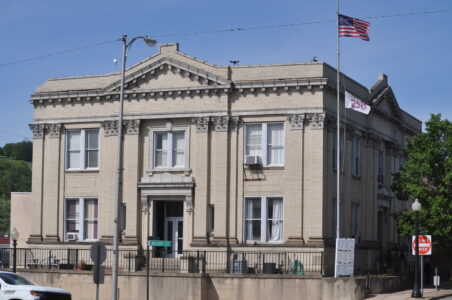
The municipal building, located at 35 S. Fifth St., houses several city offices and the police department. City officials have previously acknowledged the building has surpassed the century mark and has experienced ongoing structural deterioration over the years.
Hunker said temporary repairs have helped slow leaks for now, but warned they are not a permanent solution.
"We got a temporary fix up there that seems to be working fine right now, but it's not going to last forever," Hunker said. "We got to get serious about repairing this building or what we are going to do."
Councilman Gus Harris questioned city officials about whether estimates had been obtained for replacing the roof.
Service Director Andy Sutak said the city previously consulted with a structural engineer and engineering firm to determine the scope of work needed to fully assess the building's condition.
"They came back with a proposal that it was going to cost to do all this groundwork to see what the estimated cost would be on the building," Sutak said, adding council ultimately did not approve moving forward with the study.
Even without a full engineering assessment, officials estimated repairs could range between $750,000 and $1 million.
Mayor John Davies said those figures could climb substantially higher.
"The ballpark estimate without getting into details was over $850,000," Davies said. "You're looking at a million-dollar project here ... and I think you would go over a million myself once you find all the other problems we have."
Officials said the roof itself is approximately 35 years old and constructed from rubber roofing material that has shrunk over time.
"The problem is, it's a rubber roof and rubber shrinks as it ages," Davies said. "It pulls on the walls."
Sutak said leaks have continued to develop in different parts of the building, including near the police department.
"We're not going to spend fifty or a hundred thousand dollars," Sutak said, noting the city is instead pursuing smaller repairs intended to stop active leaks.
The debate quickly expanded beyond the roof itself as officials discussed concerns involving electrical systems, windows, asbestos, lead paint and structural integrity hidden within the building's walls.
"When they start tearing into things, things fall apart," Hunker said. "Tell me there's not asbestos. Tell me there's not lead in the paint on these walls."
Auditor Jack Regis cautioned council members about taking on additional long-term debt for a building that may continue to require costly repairs.
"Right now as of today the city stands over $11 million in debt," Regis said. "Do you want to keep adding to that debt?"
Regis warned that repairing one problem could reveal several more.
"You may fix the roof but then you don't know what's in the walls," he said. "You don't know what's in the wiring."
Sutak agreed that a complete structural evaluation would be necessary before the city could pursue federal funding opportunities or even determine the full scope of repairs.
"The only thing that I can see that could be possible for funding is through USDA," Sutak said, adding the funding would likely come primarily in the form of loans rather than grants.
According to Sutak, USDA financing could potentially stretch repayment over 25 to 30 years.
Harris questioned whether the city should assume additional debt at all.
"Right now, it seems like to me, we are just throwing money down a rabbit hole," Harris said.
Some officials suggested that constructing a new municipal building may ultimately prove more practical than rehabilitating the current structure.
"Do I think we need a new building? I think we do need a new building," Davies said. "I think for $1 million, we could build a nice building."
Sutak added that a newer, single-floor facility could better meet accessibility needs and operate more efficiently for the city's current size.
"Instead of continuing to put money into an older facility it would probably be the right thing to do is to design that fits your community," Sutak said.
Still, officials acknowledged a replacement building would create additional financial challenges, including demolition costs and securing funding while the city continues paying existing debts that stretch decades into the future.
"The bottom line is, we would love to have a new building, but how do we pay for these things?" Sutak said.
The city is also pursuing a historical designation for the building. Officials said paperwork is expected to be submitted July 1.
When residents asked whether purchasing and renovating another building in town could be an option, Davies said constructing a new facility on city-owned property may make more sense if repair costs continue escalating.
"We have property on Fifth Street. We have property on First Street. We have multiple properties," Davies said.
Council took no formal action on the issue, though Davies said he believes the matter should be referred to committees for further discussion.