
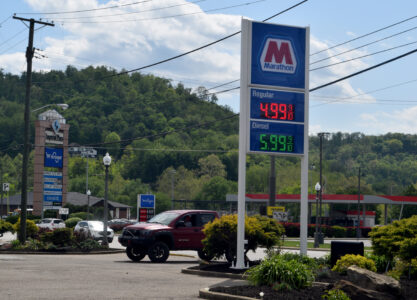
Gas prices rising throughout the Ohio Valley. Why and how much they rise is tough to explain
Trending
STEUBENVILLE -- The price of gasoline continues to rise across the country.
What residents who reside in the Ohio Valley are paying per gallon, though, depends on where you live.
“Gasoline pricing is one of the most difficult things to explain to consumers,” Traci L. Nelson, president of the West Virginia Oil Marketers and Grocers Association, said Monday. “There really isn’t another product where the price is displayed on a large sign outside for everyone to see and compare in real time. Because of that visibility, even small differences stand out. The reality is there are many moving parts that go into the price of a gallon of gasoline, and those factors can change frequently.”
GasBuddy reported Monday afternoon that the average price for a gallon of regular unleaded gasoline nationally was $4.445. That’s an increase of 34.2 cents over what Americans were paying last month and $1.32 higher than they were paying at this time last year.
Residents across the region, however, are finding they are paying more -- or less -- than that average, depending on the area they live in.
West Virginia reported an average price of $4.30 a gallon, about 35 cents a gallon more than this time in April, and a $1 more than a year ago. If you buy your gasoline in Ohio, you are paying a lot more per gallon, the Dallas-based company that tracks gasoline prices reported. The average price across the Buckeye State Monday was $4.86, $1.11 higher than last month and $1.73 higher than last May. In Pennsylvania, the average price per gallon was $4.52, up 38 cents from last month and $1.19 since last May.
There are many factors that go into the price of a gallon of gasoline, experts said, including taxes charged per gallon.
“Crude oil accounts for 50% to 60% of the price of a gallon of gasoline,” Lynda Lambert, spokesperson for AAA East Central, said Monday afternoon. “And, as we know, oil has been trading at more than $100 a barrel, mainly because of the war in Iran and the situation in the Strait of Hormuz.”
Other costs that factor into the price are taxes, distribution and marketing, which can vary from state to state, she added.
The price of every gallon of gasoline across the United States includes a federal tax of 18.54 cents per gallon. On top of that, states charge different tax amounts: West Virginia, for instance, tacks on 36 cents per gallon, while Ohio adds 38.5 cents per gallon and Pennsylvania 58 cents per gallon.
“A key factor for West Virginia is that we do not have pipeline access for gasoline distribution, so all fuel must be brought in by truck or barge,” Nelson explained. “That adds additional transportation costs compared to states with pipeline infrastructure. Proximity to supply sources and any required fuel blends also impact the final price consumers see at the pump.”
Refinery outages that have been seen through the Great Lakes region also factor into higher prices for our area.
Lambert said three major refineries in the Midwest reported disruptions during the past week. A BP refinery in Whiting, Indiana, was hit with a power outage, while two refineries in Illinois also reported disruptions.
“That is having an impact on prices in the Great Lakes region and the Midwest,” Lambert said.
Some consumers have expressed frustration that the price of a gallon of gasoline can be a lot higher -- or a lot lower -- at stations located within a few blocks of each other.
“Stations often have different pricing based on when they last received a fuel delivery and what they paid for that load,” Nelson said. “Beyond that, overhead costs can vary widely -- things like rent, labor, utilities and other operating expenses all play a role.
“Stations make independent decisions about pricing strategy,” she continued. “Some may price lower to attract more customers, while others may maintain slightly higher prices based on location, brand or convenience. Those combined factors can lead to noticeable price differences between nearby stations.”
Lambert agreed.
“As far as differences in prices block by block, stations are free to set the prices where they choose,” Lambert said. “Some choose high, some choose low. A particular station one day might go up, and then go down.”
In Ohio, Harrison and Carroll counties each reported an average price of $4.87 per gallon, while Jefferson County stood at $4.82, Belmont County at $4.79 and Columbiana County at $4.72.
In West Virginia, the average price in Hancock County was $4.52 and in Brooke County it was $4.50. Ohio County’s average was $4.31, while Marshall County’s average was $4.30.
In Pennsylvania, Beaver County reported an average of $4.70, while Allegheny County’s average was $4.68 and Washington County’s was $4.63.
Nelson said it’s impossible to predict when -- or if -- prices will fall.
“This is where we need a crystal ball,” she said. “Gasoline prices are largely driven by global crude oil markets, seasonal demand and geopolitical factors, which make short-term predictions challenging. As we move into higher-demand travel seasons, prices can remain elevated. While there might be periods of modest decreases, any significant or sustained drop would depend on broader changes in crude oil supply and overall market stability.”