
DeWine takes first trip across Blaine Hill Bridge after two-year closure
Bridge opens ahead of schedule
Trending
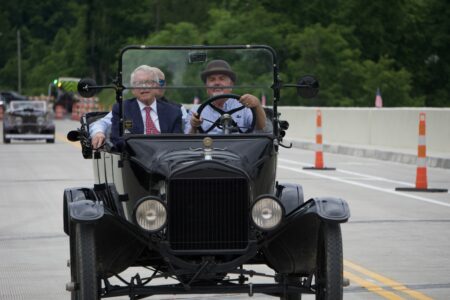
BLAINE -- Ohio Gov. Mike DeWine rode across the newly reopened Blaine Hill Bridge on Friday, marking the official return of traffic to the historic National Road span after nearly two years of closure.
He was escorted by Belmont County resident Jeff Kirk in his Ford Model T as officials celebrated the completion of the project and the full reopening of the bridge, which had been expected to initially reopen with only one lane of traffic but is now fully open.
"We knew what an inconvenience it was to the community once this bridge was closed, and closed for safety reasons. We knew we had to move forward, and we’ve been doing that. Just talked to a lady a moment ago, and she said, 'You know, the people who work on this bridge were out here in terrible weather, raining, cold, everything.' So I just salute all the construction workers, everybody who was involved in building this," DeWine said. "We actually moved money around at ODOT [Ohio Department of Transportation] to really try to speed this up, so we could get right on it. We made sure, frankly, that we were using all state money, because once you get into the federal money, then it slows things down a little bit, and we knew this was imperative to get it done."
ODOT closed the Blaine Hill Bridge, also known as the Arches of Memory Bridge, in August 2024 after a routine inspection revealed significant deterioration, including cracking on the deck and damage to the columns and concrete structure.
Built in the 1930s, the reinforced concrete bridge consists of four iconic arch spans and connects the local communities of Blaine, Boydsville, Lansing, Brookside and St. Clairsville.
It initially closed the westbound lanes of the bridge on U.S. 40 "out of an abundance of caution" while crews addressed structural deficiencies. Soon after, ODOT and the Ohio State Highway Patrol received multiple reports of drivers either not understanding or not obeying posted signs and traveling west in the open eastbound lanes, leading to several close calls that could have caused serious traffic collisions.
The project was completed by Beaver Excavating Co. and cost $17,016,026.
"I think we’ve all had experience of a road close, and what a pain it is, and sometimes it’s just kind of an annoyance, but we knew with this bridge it meant more than that. You got EMS that has to come across here, so you don’t want to slow that down any time. You’ve got people got to get to work, so we knew that this was important," DeWine said.
He added that he roughly has 200 days left until his term expires and expressed his desire to complete many of his projects but assured Ohioans that whoever fills his seat in November those projects will continue as scheduled.
Belmont County Commissioner J.P. Dutton then spoke. He began by saying he plans on being brutally honest that the past couple of years the bridge has been closed have been incredibly difficult.
"This is a main artery for Belmont County, and anytime you have an area like that blocked off from fire, EMS, even from an economic standpoint, it can be challenging," Dutton said. "I will give kudos to the Ohio Department of Transportation for basically hearing us throughout this process. I know it involved many conversations trying to express what this corridor means to us, which I know they knew, but I know at times it became very challenging, and we tried to work through that as much as we can. They’re great partners for all of the projects that go on across Belmont County, and for that, Governor, your team, we appreciate very much."
He then thanked DeWine for being in Belmont County yet again.
"He’s a constant visitor to Belmont County and has been throughout his career, and that’s always been appreciated," Dutton said.
He added that he wants to personally thank DeWine for the continued work he's done for Appalachian Ohio.
"When you close a bridge, it’s tough if you live in the area. And I just would say that we did listen, ODOT did listen, we did hear you," DeWine said. "I will say that you had a little help there, not just a little bit, but from your representatives, Congressman [Michael] Rulli made it pretty clear to us the urgency, as did Representative [Ron] Ferguson, Senator [Brian] Chavez. They do a good job representing you, and they made it really, really clear to me and the governor’s office, as well as ODOT, that we had to move on this, and that we had to do it as quickly as we can. So I salute them, and I thank them."
ODOT Director Pamela Boratyn said ODOT streamlined environmental reviews and historical preservation clearance, cutting four months out of that timeline without bypassing critical ecological safeguards, and collaborated with design consultant Michael Baker to accelerate plan development in the final engineering phase.
She added that it saved six months in the design schedule.
"By compressing the schedule, conducting project reviews and engineering designs concurrently, it expedited the plan by a year," Boratyn said.
She added that ODOT and Beaver Excavating Co. ensured that all time savings were achieved through administrative efficiency and scheduling innovations without ever compromising its strict structural and safety standards.
"Anytime we begin a project, particularly one of this magnitude, our goal is to not only make the infrastructure safer, but anticipate the needs of the community and build something that will last for generations," Boratyn said.