
Residents, first responders reflect on Ohio County floods one year later
Trending
Talk to those who experienced the floods that tore through Ohio County one year ago this weekend, and their reflections often come back to the same thing.
In their lives, they had never experienced anything like it. Not the speed. Not the force. Not the destruction.
"It was like seeing what we see all the time on national TV, when tornadoes come or hurricanes come," said Ohio County Emergency Management Director Lou Vargo.
But, instead of on a television screen, from the safety of a living room, people in Valley Grove, Triadelphia and parts of Wheeling were watching devastation unfold right before their eyes. In a matter of hours on the night of June 14, they saw flash floodwaters rage past their homes - and through their homes. They saw storage containers, cars and trees sail past them, some destroying whatever was in their path.
By the time the waters receded and the sun rose the next day, there was a fuller understanding of what was lost. Cars were gone. Homes were gone. Loved ones were gone.
The months that followed were spent picking up the pieces, rebuilding or, in some cases, completely starting over. In the face of tragedy, the spirit and resilience of those affected communities shone through, even when things looked their darkest.
One year later, the work is far from done, and the memories of that night are ingrained in the minds of victims, volunteers and first responders alike.
They never experienced anything like it before. And they'll never forget.
A Night Of Chaos
Doug Nelson was headed back to his house in Valley Grove after getting something to eat. His wife, Susie, was with their kids and Susie's mother in London. Nelson was home alone with the family dog, Sadie. It had rained hard in Elm Grove on his way back, but by the time he got to Triadelphia, the rain had stopped.
Once he sat down on his couch to watch television, the heavens opened up again.
"It was like no rain I had ever heard before," Nelson said. "And it kept going on and on and on."
Around the same time, Vargo could see the rain coming toward him from his home near Washington Avenue and it smacked his porch with intense force.Yet in other parts of Wheeling, like Mozart, where Wheeling Fire Chief Jim Blazier lives, it was a sprinkle.
What surprised everyone was how intense and how localized the strongest parts of the storm were. According to the National Weather Service, more than three inches of rain dumped on Valley Grove in just 62 minutes.
The rain was so intense, Nelson started to get worried. He set down his plate and looked out his front window. Wheeling Creek runs right past his front yard, but the drop off from his yard to the creek is deep enough that he rarely sees the water. The first time he looked at the creek that night, the water was nowhere to be seen.
That changed not five minutes later.
"I stood up and looked out again, and the creek was even with the drop off," Nelson said. "I started getting a little concerned. And as I watched, the creek came up about halfway into our yard."
Nelson remembered the stream that would come down from the top of the hill behind his house. When he walked back there, he saw that the water was washing over the culvert that usually carries it down the hill.
"I was out there five minutes tops," Nelson said. "I came back and looked out our front window again, and the creek was coming through our basement window."
The flood waters tore through Nelson's basement with such force that it blew open the basement door and sent a woodburning stove, a freezer and a pair of 500-gallon heating oil tanks flying. Nelson grabbed Sadie and headed for higher ground at his next door neighbor's house to wait out the flood.
During that time, he watched the floodwaters carry a large tree standing straight up - "like it was planted in there," Nelson said - and obliterate the bridge that connected the Nelsons' home to National Road.
Throughout the ordeal, Nelson was texting his wife, trying to explain what was happening in front of him.
"I couldn't believe how bad it was," Susie Nelson said. "It was hard to visualize and, of course, I was worried. And then, obviously, I couldn't go back to sleep."
Vargo and Blazier found themselves working through a sleepless night as well, as they helped lead the rescue efforts throughout the county. Blazier said he was able to get as far as Elm Grove, but the reports he was getting from Wheeling firefighters who made it into Triadelphia were staggering.
The scene in Elm Grove was harrowing enough. Wheeling Creek, which usually flows well below the Shilling Bridge, was flowing over it, sending debris deep into the neighborhood. Trucks banged against the bridge as the water rushed through.
"For several hours, it was complete chaos," Blazier said. "The calls for service were coming in, and we were trying to ascertain if we had anybody or if we were able to get to them. It's kind of almost like a helpless feeling to know that we had conditions that were that bad, that even with all the assistance we received from around the area, it was still iffy if we could get to some people."
Vargo was able to make it into Triadelphia and got as far as the corner of National Road and Dallas Pike Road. He had to move his vehicle twice to higher ground to keep it out of harm's way. He said the swiftwater rescue teams that plucked victims from out of the floodwaters and from homes did amazing work.
Vargo said the teams conducted 15 rescues in the water, swimmers pulling victims out of the creek. Ohio County Sheriff's deputies, Wheeling firefighters and other area volunteer firefighters performed around another 75 rescues where they weren't in the water pulling out victims, but were helping residents out of their homes and into safe spots.
The only disaster that compared to this flood, both Blazier and Vargo said, was the Weegee Creek flood in Belmont County that happened 35 years prior to the day. Even then, Vargo said, the Wheeling Creek flood was a disaster at a level he had never seen before.
And when faced with such an unknown, all first responders can do is think back on their training, Vargo said.
"This is what all of us as first responders train and drill for," he said. "You just have to rely on all your experience."
The damage was catastrophic. Nine people lost their lives. Vargo said 37 homes were destroyed, 350 sustained major damage and another 300 suffered at least some damage. According to the West Virginia Division of Highways, 41 miles of roads in Ohio County needed millions of dollars in repairs.
The physical and structural toll of the flood was devastating. The emotional and mental toll of the flood was just the same.
The Damage We Don't See
Doug Nelson still gets nervous when he hears a storm is coming.
"I have more weather apps on my phone than regular apps," he said.
And when his phone alerts him to a severe storm entering the region, he checks all of them. When bad weather threatens, he said his mood will switch 180 degrees and it's all he can focus on.
"Just this past weekend, we went to the movies," he said. "I knew rain was coming. And I was on the edge whether I should go or not. And I was thinking to myself, 'I've got to get out of this. I just need to go.'
"Well, then I get a vibration on my phone and I check in the movie theater ... movie time's over for me," he continued. "I get up, walk out of the movie theater and I go into the lobby and look out the door so I can see what's going on. Up at The Highlands, it was raining so hard, and I just wanted to go. I wanted to get out of there."
On top of the disaster itself, the Nelsons' current home is Doug's childhood home. Decades of family memories that were on display in the basement were washed away, which makes the path forward even tougher.
That reaction isn't uncommon among those who have been through natural disasters, said Julie Gomez, the executive director of the National Alliance on Mental Illness' Greater Wheeling chapter. And often, the mental and emotional toll of such a traumatic experience gets pushed to the wayside as the physical toll is dealt with.
"People often suffer in silence," she said. "They don’t often talk about it. They feel like ... 'I should be able to deal with this on my own,' or 'I should be able to get over this. Why am I struggling every single time it starts to rain really hard, or there’s a storm?'
"It’s hard for people themselves to sort of process to be able to talk about," she continued, "and we also have this thing called stigma, where people are like, 'whatever, you should be able to get over it, that’s not real, suck it up, you’re fine.' And so being able to address all of those things is challenging and difficult for us as individuals, and us as a community, and us as a society."
That's why Gomez was so excited to see the Ohio County Family Resource Network begin a series of monthly community gatherings at the Valley Grove Volunteer Fire Department. There are no structured programs at those gatherings, though licensed therapist Veronica Reynolds is there for support. It's simply an opportunity for those affected by the flood to come together and share their experiences and emotions.
"Storytelling saves lives," Gomez said, "so when people can come together and they can share their story, one, it’s like almost that physical release of it’s not on my shoulders anymore, I’m able to get it off of my shoulders, that so healing, and two, to hear other people’s stories and know you’re not alone and know that what you’re experiencing now is similar to what other people are experiencing. It makes you feel like, 'I’m going to be okay,'"
Doug Nelson said he was initially hesitant to attend those gatherings, but he always ends up going. He said being around others, talking about his experiences and listening to what others have to say has helped.
"Once I get to start talking about it, I start to feel better," he said. "Down there, it's not just me. It's everyone else that's there. We sit around and just talk about our experiences through it and what we've done to mitigate what has happened and what everyone else is going through.
"You realize, it's not just me," he said. "It's everyone else."
Rebuilding And Lessons Learned
When first responders work through an unprecedented natural disaster, one silver lining is that they have a new data set from which to work. What was unknown is now known, Vargo said, and they have new experiences to draw from.
One thing Vargo learned was that Ohio County needed more swiftwater rescue teams.
"It's June," Vargo said. "Mother Nature can play havoc on us again. The fire department has a great swiftwater team. Luckily, this was an isolated event, but sometimes they're called to other counties."
So public safety departments in the county have increased their numbers and their training in swiftwater rescues, Vargo said. WVU Medicine Wheeling Hospital also provided a boost by donating an underwater drone that makes searching submerged trees and cars more efficient.
Blazier said first responders in Ohio County made a ton of valuable resource connections through the flood recovery process.
"There are different agencies around us that were able to assist us with different equipment, manpower and so forth," he said. There's organizational software that's available to map the areas we're searching ... so we don't duplicate efforts."
Something that everyone learned was the kindness and willingness to help from the surrounding community. Lehman's Landscaping and other volunteers helped the Nelsons remove 28 tons of mud and debris from their property. Some were family members. Some were friends. Others were kind strangers.
"There were people who I had no idea - and to this day, I have no idea - who they were," Doug Nelson said.
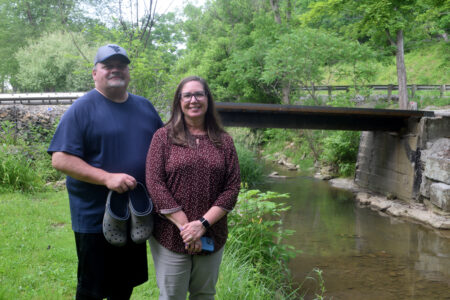
Someone came by the Nelsons' house to give Doug a pair of work boots. The floods had washed away all his shoes except for a pair of Crocs that he was using to clean up the debris. He still hasn't washed the flood mud off of them.
Susie Nelson is executive director of the Community Foundation for the Ohio Valley, which started a Disaster Response and Recovery Fund for those in the region who have suffered through disasters. That fund was kickstarted by a pair of $25,000 donations from WesBanco and The Paisley Foundation, and donations from others kept coming in after that.
Susie Nelson also serves on the Long Term Flood Recovery Committee, where she has a unique position of being an advocate for flood victims while a flood victim herself. In that role, she has learned some crucial information, including the fact that FEMA will pay for the first three years of flood insurance for flood victims, but those victims must take up the payments themselves afterward, or they won't be eligible for FEMA aid if another flood hits.
One year later, the rebuilding continues in Ohio County, both physical and emotional. As the months roll on, the physical reminders will vanish. Homes will be rebuilt. Debris will be removed. Yet other reminders will remain. Doug Nelson still remembers sleeping on his back porch for two nights after the flood, worried whether the house's foundation would give way. Susie Nelson got reminded when she went looking for Christmas decorations and remembered they were in the basement, pitched out along with every other item down there.
The Nelsons, as are every family affected by the floods, continue moving forward. Triadelphia United Methodist Church is dedicating its memorial to the nine flood victims Saturday. Valley Grove is having its community picnic the same day. It will be another opportunity for those communities to come together and display the resiliency that has helped them through tragedy.
Doug Nelson wants to go to both. He wants to be with his neighbors. But he said that may be a decision he makes that day. The memories of that night one year ago may still be too strong.
"A year later," he said, "it's still fresh."