
Underground Railroad Museum develops powerful new exhibit
Soil from Ohio lynching sites collected
Trending
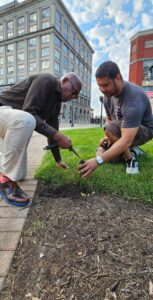
FLUSHING -- As the Underground Railroad Museum prepares to move from Flushing to its soon-to-be home, the Black Horse Inn in Morristown, museum Director Kristina Estle and board member Anthony Atkins have been planting the seeds of a new exhibit.
Behind the scenes, the duo recently completed a trip to locations of recorded lynchings in Ohio.
Estle and Atkins traveled to Coshocton, Galion, Sandusky, Cleveland, Urbana, Rushsylvania, Springfield, New Richmond, Athens, Oxford, Cherry Fork and Jamestown and collected soil to create a new exhibit for the museum.
"We drove all around Ohio to the lynching sites and collected soil in jars to commemorate the 15 lynchings in Ohio," Estle said. "Because of that, I kind of decided not to do anything for Juneteenth, because I knew I’d just be getting back from this, and I knew that was going to be a lot. That trip was funded by Belmont County Tourism Council, and it's been a year in the making, it was a huge project."
She added that many residents are unaware those lynchings occurred in Ohio and were not just a Southern phenomenon.
"There was a lot, well there still is a lot of discrimination against the black communities," Estle said. "But back to Juneteenth, I think this is really important. So, after the ending of slavery in America, that angered the white population, so the discrimination against the black communities only heightened because of the ending of slavery. The KKK was founded shortly after the ending of slavery in Pulaski, Tennessee. So these hate groups began springing up and just rain terror on the black communities. Juneteenth is very interesting, because President Abraham Lincoln passed the Emancipation Proclamation, and it was supposed to end all enslavement against rebelling territories, basically southern states, but for some reason that we don’t really understand the rules. Those rules were ignored in Texas. Basically, Texas just pretended like the Emancipation Proclamation did not happen for two and a half years."
On June 19, 1865, some 2,000 Union troops arrived in Galveston Bay, Texas. The Army announced that the more than 250,000 enslaved Black people in the state were free by executive decree. The day became known as Juneteenth among the newly freed people of Texas.
Estle said that although she did not plan any Juneteenth celebrations at the museum this year, she believes the move to Morristown will allow for a larger event because of its proximity to Interstate 70.
In 2024, the Underground Railroad Museum received $3.9 million from Gov. Mike DeWine's Appalachian Community Grant Program. The program is part of a $154 million investment in Appalachian downtowns and destinations. One of the requirements of the grant is that the project be completed by October.
The exhibits will be created and installed by COSI and Fire Watch Design with the goal of providing visitors with a unique and educational experience.
Atkins said this was the perfect time to create the new exhibit because the museum is nearing completion.
He added that he joined Estle because she asked board members whether anyone could help and he was available.
"As a board member, there really isn’t that much asked of us for the most part except to attend meetings, give our opinions, and use our professional knowledge in any way we can," he said. "So I figured this was a pretty good way to contribute more than what I normally contribute. It was also a good chance to get my hands dirty in a sense. I thought of it as helping to contribute to the overall organization."
Estle added that the Flushing location will remain operational until a few weeks before the opening of the Morristown museum.
She said she recently decided to add Wednesday to the museum’s operating schedule in hopes of generating more revenue.
The Flushing museum will be open Wednesday, Thursday, Friday and Saturday from noon to 3 p.m. Walk-ins are welcome, but she asks large groups to give her advance notice so she can schedule a separate tour.
"We’re open, we’re ready, and we’re probably going to remain open at our current location in Flushing until probably September. Then we’re probably gonna have to close for a couple weeks to do the actual move," Estle said.
She added that although the project is receiving millions of dollars, the museum itself is not receiving operating funds.
"I think it’s important to note that the Underground Railroad Museum did not actually receive any grant funding as part of this project. We did not get anything for operations or for anything, so we still really need the community support, we really need donations," Estle said. "It was a bad winter for us, well for everybody, but we weren’t getting visitors but now things are starting to look up, but we’re still in a financial hole."