
History preserved in Mount Pleasant with annual Pilgrimage
Trending
MOUNT PLEASANT -- Working to ensure the history of their small community is preserved is important to members of the Historical Society of Mount Pleasant.
That’s why the organization continues to host its annual Pilgrimage, which includes tours of many structures, some of which were built in the early 1800s.
This year’s event has been scheduled for Aug. 1-2 and will feature stops at about a dozen historic locations and will include a quilt show at the Quaker Yearly Meeting House and a car cruise.
“The Historical Society of Mount Pleasant was formed in 1948 for the express purpose of protecting the Quaker Yearly Meeting House,” explained Tom Haynes. “The meeting house went to the state and the state still owns it. The Ohio History Connection administers it, and the historical association is the site manager. We do tours and alert them to maintenance issues.”
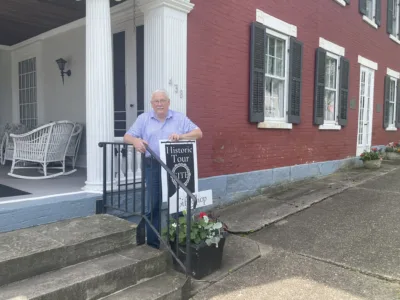
Haynes, the president of the historical society, was speaking while enjoying a recent morning sitting on the porch of another building that will be a part of the tour, the Elizabeth House Mansion Museum. While that structure was built in 1835 and first served as the home of John Gill, whose mill produced what was then considered to be the highest-quality silk available, the meeting house was built between 1814 and 1815 at a cost of $12,345 -- which is equal to about $235,000 in today’s money.
With seating for 2,000 people, it was the first Quaker Yearly Meeting House to be built west of the Allegheny Mountains and was the site of Ohio’s second anti-slavery convention in 1837.
While the Quakers held their last yearly meeting there in 1918, the building remains in use today.
Other stops on the tour will include:
• The Mercer House, which was completed in 1884 after 34 years of construction;
• The Tin Shop, which was built in the 1840s and includes the tools and equipment that a tinsmith would have used during that period;
• The Brown House, which is actually two neighboring houses that were built in 1830 and connected in 1910;
• The Presbyterian church, where visitors will be able to see its stained-glass windows;
• The Burris Store, which was built in 1895;
• The Shumard House, which features carved plaster ceilings and black marble fireplace mantles;
• The Butler House and Gardens;
• The United Methodist Church, which will showcase a collection of aprons during the tour; and
• The Irish Ridge Farm, which will display a drover’s wagon and includes two barns that house an extensive collection of tractors and farm equipment.
The farm, Haynes added, will be the site of a car cruise on Aug. 1, which will run between 10 a.m. and 2 p.m.
Tickets for the tour cost $20 each, while children under 12 will be admitted for free. They will be available in two locations -- at the Burris Store and at the farm. Haynes said cash or checks will be needed to purchase tickets. The tour will run from 10 a.m. to 5 p.m. on Aug. 1 and from 1 p.m. to 5 p.m. on Aug. 2.
A building that organizers had planned to include on the tour that won’t be available is one of the oldest in the community -- the Harris-Bone Store, which was built in 1804 -- one year after Ohio became a state. It once was the home of Pickney Bone, who served as a drummer boy during the Civil War.
That building was damaged on July 8 when a tractor-trailer failed to make the turn at the intersection of Union and Market streets. It isn’t the first time that has happened, Haynes explained, adding that when an historic building is damaged, repairing it can be a complex process.
“It’s easy for people to say that our insurance will take care of it,” he said. “But you have to track down the builders and get the estimates. Then you have to empty the building, and when they’re done, you have to clean it and put the stuff back in. I’m thinking, no, it isn’t as simple as you think it is.”
No windows were broken, he said, but some are now sitting crooked, and the building has been shifted to the point that you can now see light coming through joints. Some of the logs are hanging differently, and mortar has fallen out, he added.
“It’s not like you have a ranch-style house that was built in 1963 and somebody hits it,” Haynes added. “Well, you just give a general contractor a call, and they fix it. But how many people know what to do with a log? And where do you start?”
The work will need to be done by a restoration specialist, he said, adding it could be years before the structure can be used again.
Haynes added those concerns become greater when you consider that some people in the community still remember the last member of the Bone family who lived in that house -- Luella Bone. It also at one time was a free labor store -- which means it did not sell items that were produced using slaves -- and sits across from the building that was once the home of the abolitionist Benjamin Lundy, and where he published one of the first anti-slavery publications in the United States, The Genius of Universal Emancipation.
Inside the mansion museum, Haynes said, visitors will find a gift shop and rooms filled with period antique furniture and glassware. While it will be open during both days of the tour, he said the museum is normally open only on Saturdays. The collection helps to show what life was like over the years, parts of which are especially interesting to younger visitors.
“Upstairs, we have a mustache curler, and they always like that,” he said. “In the morning, you would get up and put it in a chimney, turn the flame up, heat it and then you would curl your mustache. And then we have the rope bed -- you would tighten the ropes on the bed, and that’s where the expression ‘sleep tight’ comes from.”
Haynes, who said he’s had family in the area his whole life, moved to Mount Pleasant about four years ago, after having spent his career in the travel business in the western Ohio town of Eaton. He’s been involved with the historical society since then.
He said another unique feature of the museum is in the attic, which is off limits to visitors. There, you can find the remnants of the knob-and-tube wiring system that was used to electrify houses in the 1880s through the 1940s. It is how electricity was added to older homes.
Events, Haynes added, help the society members raise the money they need to continue the preservation of Mount Pleasant’s history. The society is able to secure small grants, he said, which make a big difference.