
A hero’s journey home: Fallen WWII soldier’s remains found, returning to family
Trending
The memory of an April phone call still gives goosebumps to the nieces and nephews of George Brozovich. When they talk about it now, their skin still tingles.
They always hoped that, one day, Brozovich - a World War II prisoner subjected to the Bataan Death March through the Philippines, who died in a prison camp and was buried in a mass grave - would be laid to rest in the United States. They knew it was long odds, yet they never lost faith.
That faith was rewarded in that phone call, one asking for contact numbers for Brozovich's family, to ultimately tell them they found his remains.
"It was a shock," said Brozovich's nephew, also named George Brozovich.
Now the family prepares for his return so that he can be buried in Arlington National Cemetery, receiving the honor he earned decades ago. Family members say this journey, for them, proves that this country, even so many years later, didn't give up on their uncle.
A Treasure Trove of Memories
George Brozovich grew up in the Nesbitt Addition area of Triadelphia, the second oldest child and oldest son of Katie and John Brozovich, one of their six children. Katie raised those children on her own from the time George was 8 years old, after their father was killed in a mining accident in Beech Bottom.
He made good grades through school, graduating from Triadelphia High in 1937. He was a member of the golf team there.
He had a sense of humor, shown in some of the letters he wrote home from the military, chiding his younger sister Rosie about a letter she wrote to a fellow soldier he knew.
"I'd like to know who helped you write the opening paragraph," Brozovich wrote, "because it was too good to come out of your head."
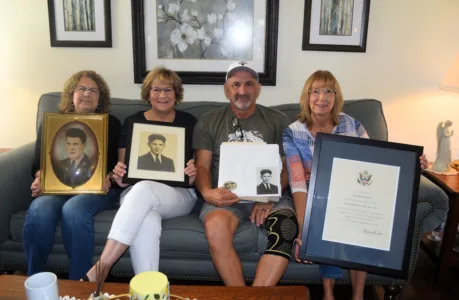
Much of what Brozovich's nieces and nephews learned about their uncle came from the letters and other documents the family kept in his memory. The older generations of the family, Brozovich's mother and his siblings, though they loved him dearly, didn't discuss him much.
"(The documents) are basically the information we have," said Brozovich's niece Cheryl Linton. "We called all our cousins and their parents never talked about him, either."
As Brozovich's nieces and nephews grew older, they grasped why the most their parents said about their uncle was that he was missing in action. After all, when would the right time be to sit a child down and tell them about the Bataan Death March?
Those documents were kept in a trunk closely guarded by Joseph Brozovich, George's youngest brother and a United States Navy veteran. He would periodically pull out that trunk, and the kids would crane their necks to see what was inside, but Joseph would only display a few items.
Joseph Brozovich guarded those items so closely, some members of the family had to pass muster to see what was inside.
"I don't know how long I was in the family before I was 'trunk worthy' enough to go up and see what was in it," the younger George Brozovich's wife Vicki said with a laugh. "We had kids already, it had to have been at least five or six years before he felt that I was worthy enough to see what was in that trunk."
The kids and their spouses ultimately understood why Joseph was so protective of the contents.
"I think it was out of respect for his brother," Vicki Brozovich said. "That was the only thing they had left for his memory. I think it was a shrine."
It wasn't until Joseph died that Brozovich's nieces and nephews could fully inspect the trunk's treasures. Those objects taught the kids how their uncle lived and, ultimately, how he died.
The Bataan Death March
After George Brozovich graduated from Triadelphia High in 1937, he worked as a coal miner until he enlisted in the U.S. Army Air Forces in September 1940. His nieces and nephews surmise that he wanted to train as an airplane mechanic, and enlisting was the best way to learn.
Brozovich became part of the 24th Pursuit Group of the 34th Pursuit Squadron in the Army Air Forces. He would routinely write home, telling his family about life in the military. He'd sometimes ask for a little money for cigarettes until he would get his canteen check. He'd ask his family to write to him.
"Every day if you can," he wrote in one letter.
After the Japanese attacked Pearl Harbor on Dec. 7, 1941, Brozovich was among the troops sent to the Philippines to fight there. In one of his last letters to his family, his stationery charted his journey from California to Honolulu to Guam to the Philippines. It was supposed to be winter in the Philippines, he wrote his mother, and the thermometer read between 90 and 100 degrees at noon.
"What the hell am I going to do when summer comes?" he wrote.
The last correspondence Brozovich's family got from him came in a Western Union telegram in late December 1941. The young man who would write pages and pages of letters to his mother, brothers and sisters had one six-word message.
"Everything fine. Merry Xmas. George Brozovich."
Troops fought the Japanese on the Bataan Peninsula. The Battle of Bataan lasted from Jan. 7, 1942, until April 9 of that year, when, in the face of nearly empty food and medicine rations, Maj. Gen. Edward P. King called for American and Filipino troops to surrender.
What happened next was what Brozovich's brothers and sisters spent their lives shielding from their children.
Around 12,000 American troops and 66,000 Filipino troops were marched around 65 miles north from Mariveles and Bagac to the San Fernando railhead. From there, they were taken by railcar and then forced to march another seven miles to prison camps in the province of Tarlac. Those prisoners were beaten and tortured routinely through the march. Among the methods was forcing prisoners to sit in the blazing sun with no helmets or head coverings. Anyone asking for water was killed.
Between 500 and 650 American troops died on that march. Brozovich made it to the prison camp, but that is ultimately where he died. According to letters from the U.S. Army, he died on July 4, 1942, from malaria and dysentery in the Cabanatuan prison camp. He was buried in a mass grave at the camp. He was 22 years old.
The family realized all was not well when one of their letters to Brozovich came back marked "Return to Sender." A letter from the United States War Department dated July 29, 1942, informed the family of the surrender and that anyone serving in the Philippines at that point would be designated as "missing" until information showed otherwise. A letter dated May 12, 1945, gave the family an official announcement of his death. Gen. Douglas MacArthur sent the family a letter dated June 2, 1945, offering his condolences.
"It was largely their magnificent courage and sacrifices which stopped the enemy in the Philippines and gave us time to arm ourselves for our return to the Philippines and the final defeat of Japan," the letter read. "Their names will be enshrined in our country's glory forever."
A letter from the Department of the Army dated Dec. 5, 1949, told the family that "based upon information presently available," the Army had determined that Brozovich's remains "are not recoverable."
In that letter, Lt. Col. W.E. Campbell added that, "should any additional evidence come to our attention indicating his remains are in our possession, you will be informed immediately."
Once Lost, Finally Found
In the years between those letters from the U.S. military, Brozovich's nieces and nephews believe their grandmother spent that time writing multiple letters to the government asking for updates on her son's whereabouts. Among the few things Joseph Brozovich would say was that his mother would never be the same after that.
When Joseph Brozovich joined the Navy, his children said he did so for a personal reason - he wanted to reach the Philippines to search for his brother. In his military career, he never reached those islands.
In his later years, Joseph Brozovich would confide in his son-in-law, Terry Hieronimus, husband of Joseph's daughter Patty.
"It weighed heavily on him," Hieronimus said. "I think he had a regret that he was never able to find his brother."
Through the years, the family would learn more about George's experience. They would receive a letter in 1975 from Abie Abraham, a Western Pennsylvania man who survived the Bataan Death March and knew George from the prison camps.
"We used to sit way into the night and talk of home and family," Abraham wrote. "He talked a lot of Katie. He loved all of you and, believe me, he fought hard to live."
Abraham would write a book on his experiences, "Ghost of Bataan Speaks," that George's family would try to read. Picturing him suffering through those conditions made it hard for them to continue.
"I start reading the book and then I get to one part and I'm like, I can't read anymore," Patty Hieronimus said.
"I can read a couple of chapters and then I just say I have to stop," said Cheryl Linton's husband Mark.
The family figured George would be lost to the war until 2017, when the younger George Brozovich and nieces Charlotte Kolb and Billie Kay Delaney all received letters from a DNA analyst asking for samples from Brozovich's family members. They were skeptical at first, but after doing some research, they provided those samples.
That DNA was the key to finding their uncle.
Groups searching that prison camp found the mass grave where Brozovich was placed. In it they found a bone from both arms, one from his left leg, his skull and his jaw. From that small sample size, they determined they had found Brozovich, 81 years after he was declared dead, 77 years after the government said his remains could not be retrieved.
Yet, in that letter 77 years ago, the government also said that, if they ever did find him, they'd tell the family immediately.
And they lived up to their word.
"I'm sure that was put in every letter that was sent home to the soldiers who died," the younger George Brozovich said. "But I'm even getting more chills to know that they finally found him."
"I think, for me personally, it gave me more trust in that aspect of our government," said niece Janice Chaykowsky, "that they are actually, truly interested in bringing these men home."
A Final Rest
Brozovich's remains are now in Hawaii and the family expects to receive them next spring. At that point, Brozovich will be buried at Arlington National Cemetery. A marker already sits for Brozovich in Mt. Calvary Cemetery in Wheeling, beside his mother and father.
The family is planning a big celebration when Brozovich is finally laid to rest. They said there will be plenty of joy, but also some sadness. They'll mourn the life Brozovich was robbed of, the family he never saw again, the family he never got to meet. They'll mourn that his mother, brothers and sisters did not live to see this day.
They'll also celebrate the legacy he left in his abbreviated life, lived through his family. There are 15 nieces and nephews. Nine are surviving - Cheryl Linton, George Brozovich, Janice Chaykowsky, Patty Hieronimus, Charlotte Kolb, Jeannine Daly, Billie Kay Delaney, Kathy Pikovnik and Rick Foster. Six have passed away - Linda Watenpool, Karen Frio, Greg Foster, Steve Foster, Nick Blaskovich and Jenny Traugh. There are 24 great-nieces and nephews, 37 great-great nieces and nephews and even six great-great-great nieces and nephews.
Though none of them were ever able to meet Brozovich, they know what his life has meant to the family over the decades. And they're overjoyed that he's finally coming home.
"There won't be a dry eye there when we lay him to rest," Janice Chaykowsky said.