
Chavez talks data centers, infrastructure at Shadyside town hall
Trending
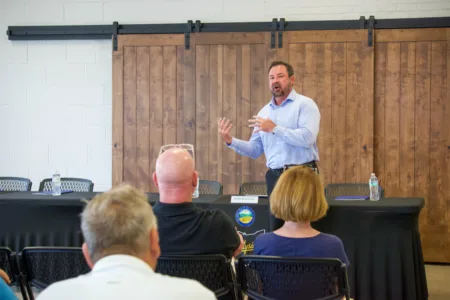
SHADYSIDE -- Ohio state Sen. Brian Chavez held a town hall meeting Tuesday evening at the Shadyside Community Center, bringing local elected officials and residents together to discuss issues affecting the region.
Chavez said the meetings are important because they give residents an opportunity to speak directly with him and make sure their concerns are heard in Columbus.
"I think that the most important focus of these town hall meetings is to understand exactly what the concerns are," Chavez said. "It’s a common theme throughout the district, but there are specifics for each community that I want to make sure that I understand to make sure that I can connect them with opportunities to hopefully make improvements."
Chavez said he particularly values hearing directly from residents about the needs of their communities.
"It’s the same story generally throughout the district, but when you hear specific examples from specific communities, that helps me when I’m talking to other my colleagues in Columbus to give them specific examples of why we are funding programs," Chavez said.
He pointed to aging water infrastructure as one issue facing communities throughout rural Ohio.
"What I’m trying to do is to make sure that I connect folks with opportunities for grants and loans because this water infrastructure that we have here was built in the 1950s, and 1960s. It’s old, it’s aging, and so we make repairs, and it causes problems in other places. It’s a common theme throughout rural Ohio everywhere," Chavez said.
Chavez said he also has been speaking with state officials about increasing funding for programs such as the Ohio Public Works Commission.
He said he put 80,000 miles on his car last year traveling throughout his district.
Chavez said he sees common themes throughout the district, including communities that once were economically and industrially vibrant. He said he wants to help those communities return to that level of prosperity.
"I think Ohio, specifically this part of Ohio, has a lot of unique challenges, but we have so many unique opportunities. The Ohio River is wildly underutilized, and so everywhere I go throughout the state, I’m saying, 'how do we get the Ohio River involved again?" Chavez said.
A significant portion of Tuesday’s discussion focused on data centers and their potential development in Belmont County.
Bellaire Village Councilwoman Elizabeth Dugmore asked Chavez about the potential arrival of data centers in the county. Dugmore said she supports data centers coming to the area but does not believe their energy requirements should fall on taxpayers.
Chavez said data centers should be responsible for the energy they consume and should help encourage additional power generation.
"The one thing specifically on energy, yes, energy prices are going up. Energy prices were going up before we had a lot of these data centers coming in because we shut down 15 coal-fired power plants," Chavez said. "So we artificially lowered the supply of electrons in the pull. Now we have data centers that are coming in that are using it; they’re paying for it, but they’re still lowering the number of electrons in the pull, which is putting pressure on rates. They’re not the cause of it, Let me be clear about that they are not the cause of it."
Chavez said proposed legislation would require data centers to provide additional power generation or enter into long-term power purchase agreements.
"What we were going to do right before we went on recess, and I say recess, I haven’t felt recess. I haven’t stopped. But what we were going to do is we were going to say data centers. If you’re going to be here in Ohio, you not only have to pay for all your energy that you’re using, but you have to bring your own power plant or you have to sign a long-term power purchase agreement with the power plant to incite more power generation units to be built here," Chavez said.
He said data centers using more than 250 megawatts would face additional requirements to ensure the amount of power they consume is replaced on the grid.
"Quite frankly, as we get more data centers and they bring more power, they’re not going to build a power plant if they need 300 megawatts they’re not going to build a 300 megawatt power plant. They’re going to build a 600 megawatt power plant," Chavez said. "So they’ll be putting more energy onto the grid so they can make some money. But they’re also prepared to expand if they need to in the future."
Shadyside Councilman Robert Dorris asked Chavez whether he would be comfortable having a data center located three miles from his home.
"Three miles is a long way. Go run three miles, because when I ran a marathon, I’m like, holy smokes, a mile a long way. I live a couple miles away from an industrial park in Marietta, right along the river," Chavez said. "Yeah, I don’t have a problem with it."
St. Clairsville Mayor Kathryn Thalman asked whether Chavez believed opposition to data centers was part of a coordinated effort by an outside force to hinder the country.
Chavez said he could not say for certain but believes there is evidence that could suggest an outside force is behind the opposition.
"We have over 224 data centers here in Ohio, and they’ve been here for almost 20 years. Until six months ago, nobody cared," Chavez said. "But yeah, so it is a coordinated effort? maybe. It’s a national effort, and it’s the same narrative across the nation. Actually, it's trying to be shut down in a lot of the industrialized countries. It is a race, it is national security, and it is very concerning."
Thalman said she believes the United States needs data centers because countries such as Russia and China have them and said she views the issue as one of national security.
Chavez agreed, saying data centers serve purposes beyond artificial intelligence.
"Ever since we stopped putting our credit card in the little slidey thing to make the carbon copy, we’ve been using data centers. Your Tap to Pay, your Venmo, and all these other things that we use are all going through data centers. 33,000 credit card transactions per second go through data centers," Chavez said.
He also pointed to navigation applications such as Waze as another example of everyday technology that relies on data centers.
"I use Waze, I don’t need Waze to get to Columbus because I go there all the time, but I still use WAZE to tell me if there’s an accident on the interstate or whatever. That’s all data."