
Data center opponents hold their own public hearing
Trending
WHEELING - A "Very Public Hearing" was held Tuesday night in Wheeling by local citizens who have vocally and actively raised concerns about the data center that is planned for development at the former Centre Foundry site in Warwood.
The public session was organized by individuals and groups that have firmly spoken in opposition to the establishment of a data center in the local community. The session welcomed input from the public, and some of the top questions submitted online prior to the event were presented during the forum.
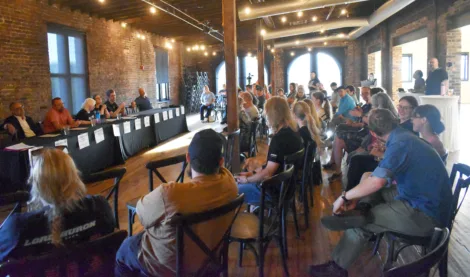
Tuesday night’s "A Very Public Data Center Hearing" took place in the third floor ballroom at Waterfront Hall and included a panel of invited guests that included city council members, a select group of community representatives who have spoken out against data centers during recent city council meetings, as well as representatives of the Silicon Foundation - the company that purchased the Centre Foundry property in Warwood and is planning to develop the site.
Andrii Garanin, chief energy and infrastructure officer for Silicon Foundation, has been in Wheeling to speak about the project and earlier this month appeared publicly before Wheeling City Council to answer questions from city officials. Garanin was out of the country and was not available during Tuesday night’s session, but attorney David Croft - who has served as legal counsel for Silicon Foundation - did participate in the panel discussion.
Wheeling City Council members Ty Thorngate and Vice Mayor Jerry Sklavounakis also attended and were part of the panel. W.Va. Del. Shawn Fluharty (D-Ohio) was in attendance but did not participate. Other panelists included community representatives Lindsay Edgington, Megan Ondeck and Andrew Mull, all of whom have spoken out publicly in recent weeks against the Warwood project.
Silicon Foundation plans to build a phased GPU data center and energy technology campus built around existing infrastructure at the former industrial site along River Road on the south end of Warwood.
About 100 citizens turned out for Tuesday night’s event. Upon entering the room, attendees were able to provide their information on a sign-in sheet and could also acquire black and white yard signs and T-shirts with the slogan of "No Data Centers In Our City" that were available.
"The city won’t give us a public hearing, so we’ll do it ourselves," stated a post shared by Upper OV United promoting the session. "We’ll see who among our elected officials makes it to the event, but we know for sure community advocates will be there with the answers you need."
Polly Barks, who has been an outspoken opponent of the Warwood data center, served as emcee for the event. Barks is one of several Warwood residents who have filed a lawsuit in Ohio County Circuit Court against Silicon Foundation in an effort to stop the project from moving forward.
Question and Answer
Questions and topics raised during the forum centered on the scope of the Silicon Foundation project, West Virginia House Bill 2014 - which sets forth regulations for large-scale data centers in the state, the number of jobs the project is expected to create, the issue of potential noise from the site, the amount of electricity the facility will use and the impact to local consumers, water use at the site and environmental concerns, along with other topics related to data centers and the Warwood development.
Croft reiterated responses to many of the questions that had been answered previously by Garanin, and the two council members on hand responded to municipal-related topics. Community representatives on the panel provided data from extensive research bolstering the stance that data centers basically destroy communities.
It became apparent that some of the specific questions raised about power consumption and utility costs or environmental enforcement would best be answered by the power company AEP and even the Environmental Protection Agency.
"I’m here not only to answer the questions that I can but also to be educated, too, so I can effectively represent everyone here," said Sklavounakis. "This idea that it’s going to increase our utility costs is a legitimate concern and a legitimate question, and I’m still trying to figure that out."
Community representatives provided information about how existing data centers have impacted other communities.
"A 30 megawatt data center - which is in the range that has been proposed, although it changes quite frequently ... there’s one that is 30 megawatts that is in a noise lawsuit right now," Mull noted. "The residents that are nearby say that the sound is like someone has a vacuum in your living room 247/365.
"You have that noise outside your house, it permeates your house - the vibrations. It’s basically like a slow version of torture."
The Bottom Line
While panelists and some individuals in the crowd shared thoughts on various topics related to data centers, it was clear that the organizers of the event, the community representatives on the panel and many of the people in the crowd held a firm and unwavering stance against the development of the Warwood data center at all. While the group expressed their thanks to the councilmen and to Croft for attending and participating in the event, they also expressed frustration in the position that city leaders have taken on this matter and repeatedly questioned the trustworthiness of the Silicon Foundation.
"Guys, look, I can tell you what I know in the agreements, but just pushing back to say ‘well, you’re going to make it bigger’ or ‘you’re lying,’ I don’t think that furthers the conversation," Croft said. "I’m here trying to give you good information. Just to push back to say, ‘well, I think you’re being untruthful’ is not a good way to communicate.
"We’re trying to establish trust here. And I get it - to hold feet to the fire on whether it’s sound or on what Andrii is asserting. But it’s unfortunate that the environment is as hostile as it is."
Panelists from the city and the Silicon Foundation’s legal representative noted that many of the groups’ concerns about the rapid and widespread development of data centers in communities across the country are valid.
"There are some bad players in the data center industry," Croft said. "There are over 5,000, and there have been some adverse effects to the communities around them. West Virginia has been historically taken advantage of, and we don’t want that to happen any longer. I don’t want that to happen, as a West Virginia resident and an Ohio County resident."
Community representatives outlined a compilation of recommendations for the next steps to be taken in their fight. So far, a number of these suggestions have been "dismissed or glossed over" by city leaders, according to Mull.
The group suggested that plans from the company and any agreement with the city be made available to the public for transparency. They suggested again that council pass a moratorium to at least temporarily stop the development of the data center.
City officials have stated previously that they cannot simply establish a moratorium to stop the data center from moving forward.
"Our legal department gave us a legal opinion saying we can’t do this. We’re not the bad guys here. Other people are telling us different things, and we’re trying to muddle through this just like everyone else."
Mull and others said they disagreed, noting that other communities across the country have passed moratoriums.
"A moratorium is a temporary ban on a data center while the community has a chance to gather more information," Mull said. "It has been passed in many places throughout the country. The entire state of New York did it just a month ago."
Residents urged city leaders to "pump the brakes" on this issue in order to "make an informed decision" on it. But city council officials said there was nothing to decide.
"One of the things that we keep losing sight of is that there’s nothing before city council right now to vote on," Sklavounakis said. "A private entity sold their business to another private entity, and there are no changes they’re asking from us. There’s no new build-outs. There’s no new zoning. There’s nothing for Ty and I to vote yes or no on. So that makes this a little difficult and frustrating for us, like it is for you."
City officials said they are taking the steps they can to reassure the public that the project will not become the nuisance that opponents fear. A memorandum of understanding is being drafted between the city and the company to ensure that the project will not become a large-scale data center, as set forth by the HB 2014 rule that they could not operate in a Tax Increment Financing district - which the city planned to expand to the Warwood site. The facility will be subject to comply with existing municipal ordinances for noise and other local regulations, council members noted.
"Companies pay millions of dollars in fines all of the time," Barks said. "They work that into the cost of doing business, so I just want everybody to be aware of that. It is not necessarily a deterrent."
Tuesday night’s meeting was held in order to give data center opponents an opportunity to ask questions about the issue in an open forum. It was noted that during city council meetings, the Silicon Foundation was given unlimited time to speak and answer questions back and forth with council members, while opponents of the project were limited to three minutes each with no responses at all from the company or the city. The forum at Waterfront Hall provided more of an open discussion with the public, organizers noted.
Barks and others on hand Tuesday night insisted that the city leaders should share the concerns of their constituents and to be proactive when it comes to issues surrounding the looming Warwood data center.
Sklavounakis said he welcomed recommendations for what actions the group would like to see city council to take.
"We want to pass a resolution stating that council opposes data centers in Wheeling," Mull said. "This is a non-binding resolution, but it’s a simple way to show that council is on the people’s side."