
Cameron outlines campaign priorities at first meet-and-greet
Trending
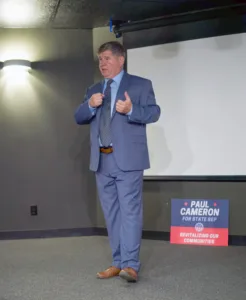
CADIZ -- As the November election approaches, Ohio District 96 Democratic candidate Paul Cameron held his first meet-the-candidate event at Puskarich Public Library in Cadiz on Tuesday evening.
Cameron introduced himself to residents in attendance and explained his positions on several issues.
He said he is running on a platform of community revitalization and making sure Columbus remembers southeast Ohio and funds it properly. He also is running in opposition to data centers.
"I feel that where we’re at right now, with where we are in society, there are some people that believe that we can do data centers, I don’t feel that we’re at a point where we can," Cameron said. "There are primarily these larger hyperscale data centers for running artificial intelligence, which are going to destroy jobs, or they’re running flock cameras and other surveillance systems, which are intruding into people’s privacy and Fourth Amendment rights, or they’re running Bitcoin and crypto mining. So who’s that benefiting? We’re not really seeing a benefit to society at the moment, not at large."
He added that he believes AI will replace workers, leaving residents without a plan, and said he wants to fight to secure their jobs.
Cameron said that while campaigning, he has driven throughout Ohio District 96, which is largely made up of rural small towns that once were coal communities.
"These towns either started as mining encampments, or they were railway hubs, or they were the centers of the industries that used the coal: your potteries, glass works, steel mills, or power plants. These industries litter the whole region, and with the decline of coal over the last 30 to 50 years, these communities as well also began to decline, and you found a situation in which the businesses would close up, and you have a lot of abandoned buildings and a lot of abandoned businesses in these areas," Cameron said. "I grew up in Weirton, West Virginia, in the 1970s and 1980s. I watched firsthand as the steel industry collapsed within my hometown, I saw my hometown get hollowed out as businesses closed, storefronts were boarded up, and people moved away to look for better opportunities."
He added that he was one of the people who left the Ohio Valley to find a better career opportunity.
In 1991, Cameron left the Ohio Valley and joined the Army. He spent 15 years out West, including nine years on active duty in military intelligence as an Arabic interrogator and two years as an activated guardsman as an anti-terrorism force protection officer.
"While I was out west, I got an associate’s degree in network management and administration, and a bachelor’s degree in Near Eastern Studies from the University of Arizona. Arizona is expensive, and so in 2006 I moved back to the Ohio Valley, found a small piece of property in Harrison County, and a fixer-upper house near Adena," Cameron said. "One of the first things I noticed about Adena when I moved there is how much it reminded me of Weirton, but very much condensed."
He added that when he moved to Adena in 2006, there was one grocery store, which had closed the year before, and the downtown section of Adena was mostly abandoned commercial buildings. There were a couple of businesses downtown, but most storefronts and businesses were abandoned.
"With coal gone, there’s no industry in Adena, there’s no jobs in Adena, there’s no reason for young people to stay. People move away, so we’re just a town full of retirees, and we’re just slowly dying off. And as we die off, the town’s going to die off as well," Cameron said. "And I saw that throughout the region."
He added that although each city, town and village has its own unique problems and concerns, many communities in the district have similar issues that need to be addressed.
Cameron said the four issues he constantly hears about are outdated sewer systems, roads that need repaired, water systems that need upgraded and dangerous sidewalks.
"Columbus has abandoned us and doesn’t care and won’t fund us properly," Cameron said. "A large part of that problem is that when the oil and gas came in, there was a large amount of tax revenue that came out of that. The vast majority of that tax revenue went to Columbus, and they were gracious enough to give 35% back to the communities where the oil and gas came from. The vast majority of that revenue is going to projects in Columbus, Cleveland, and Cincinnati. Likewise, when we get funding in the state, and there are grants and there are programs, the cities that get funded are again Columbus, Cleveland, Cincinnati, and maybe Dayton. We’re competing for these grants, and they’re not getting back to us, and they’re not approving a lot of the grants in this area that are desperately needed."
He also spoke about recent difficulties experienced by Cadiz with its water system, which resulted in discolored, foul-smelling water.
Several options are being considered by the Ohio EPA, including constructing a new water plant near Cadiz, connecting to Tri-County Water through a new line from Martins Ferry, extending a 10-inch line from the Jefferson County Water and Sewer District to supply Cadiz or having the Jefferson County Water and Sewer Department and Harrison County Water supply Cadiz through their existing 8-inch lines.
Cameron said he believes a problem with the plan is that if Martins Ferry has a water issue, it could mean Cadiz would have one as well.
Cameron will host three town hall meetings in September. He will be at the Kevin Barr Event Center in St. Clairsville on Sept. 15, the Barnesville Library Annex on Sept. 18 and the Caldwell Community Center on Sept. 23.