
No bids, plenty of questions for former EORH property
Trending
MARTINS FERRY -- With no bids offered for the former East Ohio Regional Hospital after the second of two public auctions, Martins Ferry officials are waiting to see what comes next for the sprawling property -- and whether another health care provider could still breathe new life into the shuttered facility.
The second and final auction Wednesday drew no bidders for the property, which had a minimum bid of $2,617,176.34. The first auction, held two weeks earlier, also failed to attract a bidder.
Under Ohio law, property that remains unsold for lack of bidders after being offered for sale on two separate occasions can enter the forfeiture process.
City officials, who have repeatedly said they hope the property eventually will again be used for health care, stressed during Wednesday’s City Council meeting that Martins Ferry does not control what happens next.
"That’s all in the hands of the county," Mayor John Davies said. "They are controlling that whole scenario -- the auction part and turning over to the land bank or whatever they deem fit. That’s in the county’s hands. That’s not in the city’s hands."
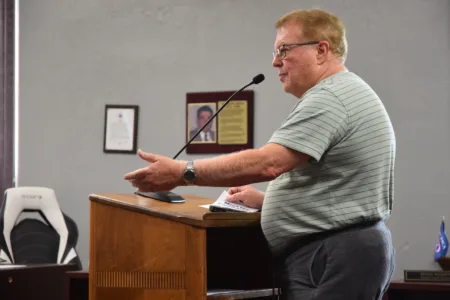
Belmont County Commissioner Jerry Echemann, a member of the Belmont County Land Reutilization Corp. board, attended Wednesday’s council meeting and addressed what could happen next.
"The treasurer’s office had its second auction at the hospital and nobody showed up," Echemann said. "Now it goes to the land bank."
City Services Director Andy Sutak, who also sits on the land bank board, said the process is not necessarily that straightforward.
"It could become a foreclosure to the state of Ohio, which would then go to the auditor’s sale," Sutak said. "If the property is offered to the land bank, the land bank would have to accept the property. If not, it would head to the auditor’s sale. It’s kind of a crazy situation."
Davies questioned what the land bank would do with a property of the hospital’s size and condition if it ultimately acquired it.
"The land bank’s major function as an entity is to demolish buildings," Davies said. "Would that be the intent? To tear down the building?"
Echemann said he does not believe demolition is in the plans.
"I don’t think so. I don’t think that’s the goal that I know of," Echemann said. "Yes, the primary function of the land bank is demolition, but I wouldn’t be for tearing it down unless someone came in and said, 'If you tear it down, we will build such and such.' Then that would be a different story."
Officials acknowledged that significant money would be needed to repair and rehabilitate the former hospital before it could again function as a health care facility or be converted for another use. They also said the land bank does not have the money needed to undertake a major rehabilitation itself.
"It really depends on how much [the property] has deteriorated, but I don’t really think anybody is thinking about tearing it down," Echemann said.
Councilman Gus Harris questioned whether liens remain attached to the property.
"It’s not free and clear out of bankruptcy, is it?" Harris asked.
Sutak said he could not say with certainty which liens remain.
"[The treasurer] put the sealed bid at $2.6 million approximately," Sutak said. "From the past, I know there were some liens. I don’t know if they are still attached or taken away. I know the bank at one time had one of a couple million. I don’t know if that was taken care of or if that’s still on the property."
Sutak also pointed to a PACE assessment that had been associated with the property. PACE, or Property Assessed Clean Energy, financing generally funds qualifying property improvements and is repaid through an assessment attached to the property tax bill.
"At one time with the PACE loan, you’re looking at probably another $5 million," Sutak said. "It could be up to $15 million or $18 million. Again, I am not sure what is or isn’t. I don’t want to say."
But two auctions ending without a bidder do not necessarily mean there is no interest in the property. Moving it further through the foreclosure and forfeiture process could eliminate some financial encumbrances and make it more attractive to a potential buyer.
"For anybody who is looking to buy it, it’s best to have it go through the process of nobody bidding, nobody bidding, because certain things do drop off and go away," Echemann said.
The property also carries delinquent real estate taxes, with any applicable proceeds distributed among the taxing entities entitled to them.
"That money is owed to the taxes, of which we would get a percentage back," Davies said.
"And school districts, city, county, village, township -- whatever is in the jurisdiction," Sutak added.
Resident Richard Hord noted that demolition is not the only possible role for a land bank.
"The land bank does more than demolish buildings," Hord said. "In Jefferson County, it is involved in refurbishing and even building new buildings."
For Martins Ferry, however, the hope remains the same -- finding a viable future for a building that once served as a major health care facility for the city and surrounding communities.
The hospital’s roots in Martins Ferry stretch back 120 years. It was founded in 1906 as Martins Ferry City Hospital by Dr. R.H. Wilson, initially operating with 30 beds and five physicians. The facility grew over the decades into East Ohio Regional Hospital and became a major health care provider for Martins Ferry and the surrounding Ohio Valley.
Its recent history, however, has been marked by repeated closures, ownership changes and financial problems.
Alecto Healthcare Services, a California-based company, closed EORH in September 2019 along with its sister facility, Ohio Valley Medical Center in Wheeling. Dr. John Johnson acquired the Martins Ferry hospital in 2020 and reopened it in February 2021, restoring hospital services to the city.
Financial problems eventually resurfaced. Departments began closing, employees reported missing paychecks and the hospital fell behind on its property taxes. EORH closed again on March 20, 2025, leaving hundreds of employees without jobs. Employees subsequently alleged they were owed wages and benefits, while the county moved forward with foreclosure proceedings over delinquent real estate taxes.
Another attempt to revive the facility emerged in June 2025, when 360 Healthcare Inc. acquired an interest in the operation and announced plans to reopen it. Those plans failed to materialize amid competing leases, lawsuits, financial problems and other legal complications.
The hospital’s problems did not end when its doors closed.
The vacant complex has since been the target of repeated break-ins, thefts and vandalism, with Martins Ferry police making multiple arrests at the property.
Police have reported suspects entering the hospital through numerous access points and stripping copper wiring, pipes and other materials from the building. In one case, officers recovered thousands of dollars worth of cut copper wiring along with saws, drills, bolt cutters and other tools allegedly used to remove it. Juveniles also have been caught with radios and electronic devices taken from the facility.
Water lines have been damaged or removed, resulting in water breaks that required the city water department to respond. Police also have found evidence that people had been staying inside the vacant complex.
The contents of the hospital have diminished for other reasons as well. Companies with claims on medical equipment have reclaimed property, while other equipment has been removed by parties claiming ownership. City officials have previously reported seeing equipment ranging from X-ray systems to components associated with CT and MRI equipment being taken from the facility.
The theft of copper wiring, equipment and other materials, combined with damage from repeated break-ins, has added to the amount of work and money that would be required to return the former hospital to productive use.