
Young Bridgeport scientists learn by doing
Trending
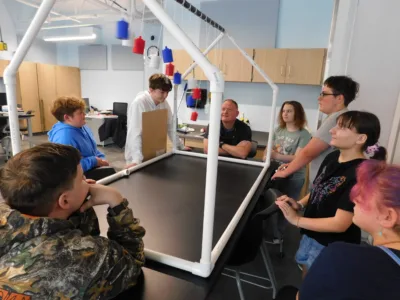
BRIDGEPORT - Bridgeport Middle School's eighth graders at John Martin's Engineering and Science Technology class are learning the ropes as young scientists and engineers. They have completed their latest project, a wave machine where pendulums swing in a precisely calculated pattern.
His classroom and lab is in the Bridge, the new multipurpose facility which opened this school year and offers opportunities for extensive project-based learning in fields such as STEAM, health and veterinary science.
Martin pointed out the mathematical curve of the wave illustrates his students' calculations.
"We've built this in order that every 30 seconds the thing will reset," he said. "In a 30-second period they're all done, and so it resets and does it again."
The pendulums will continue to swing until friction stops them.
"The physics of a pendulum is such that the length is proportional to the period, the length of time it swings," he said. "The period is proportional to the square root of the length, so if you build an apparatus that has that shape, you can arrange things so that it forms a wave that repeats."
His students calculated the lengths of the strings, used the 3-D printer to make weights, and built the structure using PVC pipe.
"They were broken up into three teams," he said. One team worked on the frame, one on the strings and one on designing and printing the weights. Each team faced its own challenges, such as deciding to shift from globe to cylindrical weights to resolve difficulties with the angles.
"Once they measured the lengths of the pendulum according to the physics, they had to attach it to the device and test it."
This was an exacting process. Students used a timer to count the swings. Each had to swing 15 times in 30 seconds.
"If you can show that the square root is the result, you can take one pendulum and swing it and count its period, then change the length, record that data, swing it, measure that period," Martin said.
"Keep recording those two things: the length of the pendulum and the corresponding period, and if you plot those on a graph, that's what shows up. It's a combination of physics, math, engineering, 3-D printing and building."
The sixth and ninth period eighth grade classes finished the project after about two weeks. There was considerable trial and error as they changed the shape of the frame, the weights and calculated the length of the strings.
"It took many iterations. We've been working on this for about 10 class periods, and we got it done," he said.
The hard work and the success they earned was also a confidence-builder.
"They were initially afraid of it, because when I announced the project they thought it was going to be impossible," he said. "As we worked through it and they started to realize how things worked, they came along."
Martin is already considering variants for future projects.
"There's a completely different way to build this, and I think I'm going to challenge the next set of eighth graders, maybe even my upper school kids to do it."
The eighth graders said they are proud of their work. Mason was on the frame team and talked about the challenges of correct measurements and timing in the project.
"Each piece had to have a certain amount of time to match on the wave machine," he said. "We never secured anything down until we had it right."
Holly was on the string team. She also had doubts when they started, but gained confidence when they progressed and came up with new ideas, such as shifting from globes to cylinders.
"When we first knew about it, I didn't know if we were able to do this," she said.
She recalled the challenge of measuring strings.
"It was a little hard, but we did pretty good," she said. "We got the right amount and we made it look awesome. It was pretty cool and fun."
Devin was on the team creating the weights and adjusting the heights.
"We designed the shape and the different dimensions," he said. "We printed it off. When we were doing this, we had to hold the strings and pull it back, we had to test it."
Cora was on the strings team. One skill they learned was tying different kinds of knots. They used chiefly square knots and figure eights.
"When he first brought it up, it was kind of shocking because it seemed like a difficult task because of how long it would take and the resources needed. I thought it was going to be harder than it looked."
Sophia was also on the strings team. She said Martin showed them a video demonstrating the project, which clarified what they had to do.
"That's when I realized what we were going to be building, and I got excited to do the project," she said. "I was surprised and I think it looked really, really cool, especially with all the patterns it does. I thought it looked awesome."