Joyce Wolen and Staff Help Open Doors to Safe, Affordable Housing
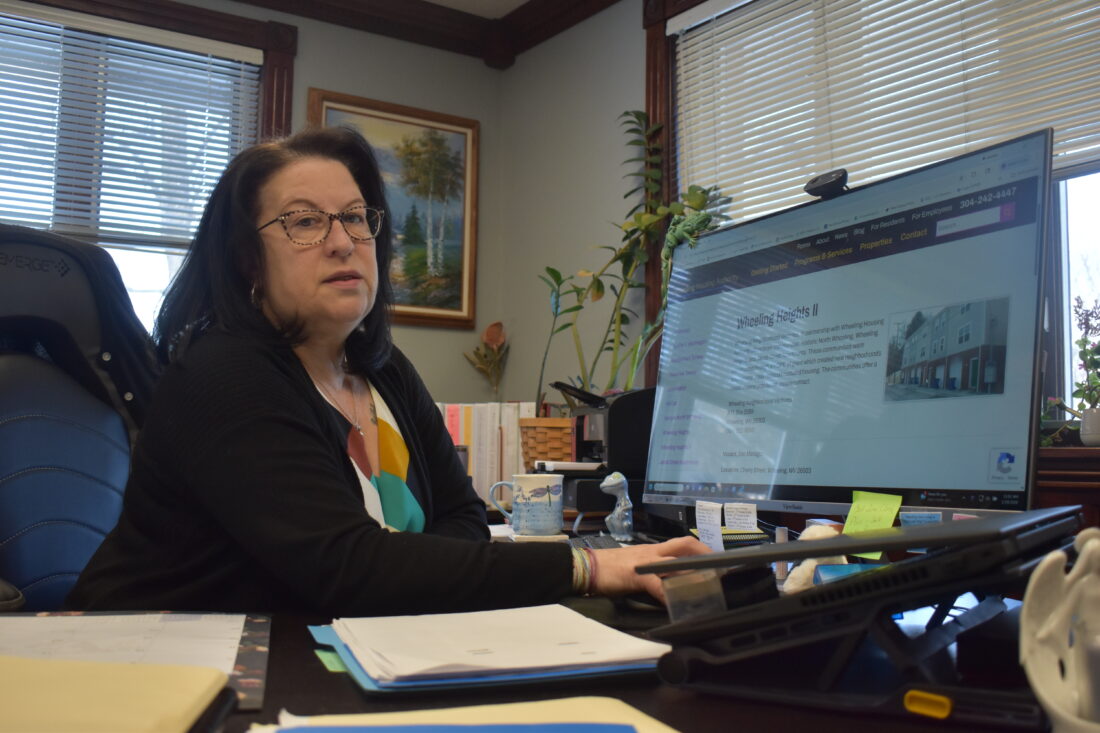
Joyce Wolen, executive director of the Wheeling Housing Authority, leads a team that is dedicated to connecting families that need a helping hand with safe and affordable housing.
WHEELING – Joyce Wolen has always called the Ohio Valley home, and for nearly three decades, she’s been part of a team that has helped countless families in the community find a place they can call home, too.
Wolen is the executive director of the Wheeling Housing Authority, where she has worked for 27 years.
“I started as the executive secretary, and then moved to executive assistant,” she said, noting that she took on a role in human resources and continued to tackle more tasks at the WHA. “I just kept increasing what I was doing, and around 2014, myself and another co-worker were named deputy directors. I completed some training programs, and then in 2018, I was selected for the executive director’s position.”
The role is challenging yet very rewarding, she noted.
“Our goal is to provide safe, affordable and decent housing – that’s in our mission statement,” Wolen said. “With that, we provide the opportunity for people who can’t rent on the private market by themselves without help, because as we know, most people don’t make enough money to afford rent, utilities, food, shoes for the kids … that kind of stuff. So we provide the assistance that they need so they can live, basically, a productive life.”
It is truly a team effort at the WHA, which serves the Wheeling area and Ohio County.
“My role as executive director is to make sure that we have the staff and the training to follow all of the regulations,” Wolen said. “There are lots of regulations, and it’s sometimes difficult to keep up.”
As with all housing authorities across the nation, WHA’s operation involves federal funding and thick stacks of guidelines that change regularly. With every administration change in Washington, new changes come to housing authorities. Congress sets it through its budget, and the U.S. Department of Housing and Urban Development brings down the regulations.
“We are technically private – a ‘quasi-arm’ of the federal government,” Wolen said. “We receive federal funding and have to follow federal regulations and guidelines.”
The WHA provides housing assistance – not free housing.
“We collect rent, and I don’t know that people realize that,” Wolen said. “Most of the people on our program pay rent. There’s a very small percentage that pays the minimum – currently set at $50 a month. HUD supplements that.”
Families or individuals may receive help with subsidized housing, but the WHA keeps count of those being served by tracking the number of residences being occupied by people who are receiving help with housing. That residence may include one individual or a family of several individuals.
“We have a total of 662 public housing units, so you’re talking thousands when you’re talking about families,” she said.
Units have from as few as zero bedrooms to as many as five bedrooms.
“Most of our stock was built a long time ago, so most are zero to one bedrooms,” Wolen said.
They can house one person in a zero-bedroom unit, up to two people in a one-bedroom unit, up to four people in a two-bedroom unit, and so on. Those who need assistance through the WHA can be placed in public housing or can use a Housing Choice Voucher or Section 8, which allows them to rent on the private market.
“That’s our partnership with local landlords,” Wolen said. “We have up to 573 vouchers. It’s the same kind of scenario, except a local landlord is getting that rent, and Wheeling Housing is using our federal dollars to fund the remainder.”
Some property owners have a direct line for HUD subsidies through voucher programs, offering lower rent. Those vouchers stay with that particular building, however vouchers issued through the WHA go with the family to an apartment complex, a house or other residential dwelling. If they move, it stays with them.
Public housing managed by the WHA include family townhouses at Hil-Dar and high rise at Luau Manor, Booker T. Washington, Garden Park Terrace and Riverview Towers, which is elderly only. There are also units in Historic North Wheeling, Wheeling Heights and Wheeling Heights II and the Jacob Street Apartments.
The wheels of government through the application process can be slow, and the demand is high for public housing assistance.
“The need is there,” Wolen said. “We always tell people that if you think you might have a need in the next three to six months, put your application in, because sometimes it takes that long. We’ve got a very healthy waiting list. Our current public housing waiting list is 613.”
Wolen noted that it is a reality that most people can be just two paychecks away from having to decide whether to pay the electric bill, the food bill or a house payment. That is why the WHA remains dedicated to serving the people in need.
“We have challenges and successes every single day,” Wolen said. “We can provide a home, and we can provide safety for them.”
The WHA has a total of 30 people on staff, including a housing manager for each site, supervisors, finance and operations personnel and maintenance staff.
“We’ve got good people,” Wolen said. “We’ve got a staff that wants to move this place forward and continue the excellence. Our maintenance staff is fantastic. They do a really good job.”
While many private landlords often struggle to keep up with regular improvements to their facilities, the WHA operates on a budget that includes capital improvement funds that help maintain its buildings and bring upgrades to facilities.
A lot has changed through the years at the WHA, Wolen noted. There were systems back in the day when staff members moved paper files around, then it progressed with the dawn of dial-up internet systems that crashed on a regular basis, she recalled. New technology brings significant changes that can be challenging in light of the myriad of regulations involved, but it has also helped streamline operations.
“Automation would be one thing that has brought us forward … a little bit,” Wolen said. “But technology is the good part and the bad part about our world.”
In the coming years, Wolen will eventually retire to spend more time with her family. Until then, there are still many goals left to achieve and many success stories that need to be realized.
“One of the most gratifying things I’ve seen are individuals who went through what’s called family self-sufficiency. They have a goal – to get out of public housing,” Wolen said, explaining now rewarding it is to see people get off of the program and buy a house. “Because they’re living in a safer rental situation, they’re able to save, they’re able to plan and they’re able to do things to make themselves sufficient.”
One of the big buzzes right now is transitional housing for the homeless community, Wolen added. A lot of individuals are not able to succeed going from the street directly into traditional public housing, she said, noting that another step in the system is needed to get them the services that they need.
“Wheeling really needs more transitional and affordable housing,” Wolen said, noting that a coordinated effort is needed to achieve this. “As long as the government continues to fund what we do, I can see continued growth and continued help for people who need it.
“Housing Authorities can do a whole lot to help address the things that are needed so that people have a chance. We give people a chance.”
Community

Rabbi Joshua Lief Is Building Bonds Between Faiths

Wheeling Native Jay Frey Back Home

Rev. Shannon Blosser: Love Thy Neighbor Of All Abilities
Amy Jo Hutchison Always Connected With Her Community’s Needs
Joyce Wolen and Staff Help Open Doors to Safe, Affordable Housing