
Sarita’s sort-of-secret soups
Trending
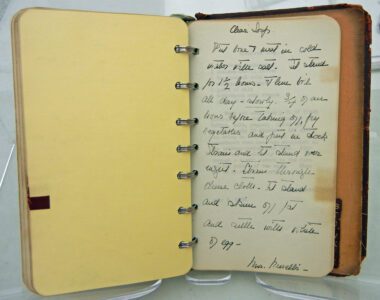
It wouldn't have been unusual for a woman of Sarita Oglebay's marriage-eligible age and uppercrust station to be dreaming up the details of an elaborate household of her own. But, a small collection of recipes assembled in the early 1900s by the daughter of shipping magnate Earl Oglebay hints at a bit of plotting.
For one thing, Sarita was, at the time, in the years-long process of becoming secretly engaged to Courtney Burton -- a young man who did not initially find favor with her father. (The couple married in 1912 and had one son before Burton succumbed to the so-called Spanish flu pandemic in 1919.)
For another, the recipes are tucked into a repurposed address book whose lettered divisions are happily ignored in favor of grouping foods by course. Some of the ingredients are written in Sarita's minimalist cursive -- few flourishes are to be seen. Some are typed.
"I wonder if she knew how to type?" pondered Kara Yenkevich, curator of collections for the Museums of Oglebay Institute in Wheeling. "It's known that Earl Oglebay had a typewriter. There are typed documents from that time."
While it's possible Sarita -- surreptitiously or not -- did type the cards, Yenkevich noted the family's wealth meant that and menu planning would likely have been as far as her connection to the recipes would have gone.
"She certainly wouldn't have been cooking them herself, but she found recipes for other people to cook," Yenkevich explained. "She was growing up, seeing her mother do that running of the household and the kitchen, and I'm sure as she was reading, she thought, 'That sounds tasty,' the same way we do today."
SOUP COURSE
Whenever and by whomever the recipes were actually prepared, Yenkevich said it is important to keep them in context.
The Oglebays ate even their family meals in courses delivered to the table by household staff. (When spending summers in Wheeling, this would have meant a short walk from the mansion's kitchen - which was plumbed for water and gas and was electrified given Earl Oglebay's penchant for tech of the day -- to the nearly adjacent family dining room.)
She noted Sarita's cookbook tends to be a bit heavy on the sweets and pastries side of things, but there are also a handful of recipes for the soup course.
Served as an early part of the meal -- as an appetizer, often after a salad or cold dish -- Yenkevich said soup would have been served in controlled portions to preserve diners' appetites for courses that would follow.
Interestingly, for all the wealth the Oglebays had, the soups are remarkably simple compared to today's hearty fall and winter fare that often presents soup as a main dish.
Yenkevich said this might be because recipes that appeared in national magazines would have had to have been restricted to ingredients that could be broadly found. Also, she noted, immigrants particularly skilled in the art of spicing -- such as a wave of 4 million Italians that came around the turn of the 20th century -- had yet to arrive on the culinary scene.
"Complexity kept on going up as we learned more and as things became more global," Yenkevich said of salt and pepper nearly standing alone in the ingredients lists.
Even still, Sarita's sort-of-secret recipes make it possible for inclined readers to at least ponder a meal fit for Wheeling's closest thing to a royal. Here are three, in Sarita's exact words, from her collection:
Clear Soup.
Put bone and meat in cold water with salt. Let stand for 1 ½ hours. Then boil all day -- slowly. ¾ of an hour before taking off (heat), fry vegetables and put in stock. Strain and let stand overnight. Strain through cheesecloth -- let stand and skim off fat and settle with white of egg.
Mrs. Muvells (name uncertain)
(Note that modern food safety standards would let the soup stand overnight in the refrigerator rather than on a counter. And, some modern cooks wouldn't use an unpasteurized egg white without reheating the stock for the same reason.)
Mushroom Soup.
½ lb. fresh mushrooms
2 tablespoons butter
1 teaspoonful salt
1 saltspoonful pepper
1 quart of milk
1 tablespoon cornstarch
yokes (sic) of 2 eggs
Wash and chop fine ½ lb. of fresh mushrooms. Put into a saucepan with butter, salt, pepper; cover and simmer gently for 20 minutes. Add milk and bring to boiling point; add cornstarch that has been moistened in two tablespoons of cold milk. Stir until soup is slightly thick. Press through a sieve; return to the fire and add yolks of two eggs. When hot it is ready to serve.
Daisy Ricks.
July 8, 1905
Gumbo Soup.
Take a year old chicken; cut in pieces and fry. After taking out the chicken, fry two sliced tomatoes. Put in a soup kettle and add six quarts of water. Boil until meat falls from bones. Take out skin and bones. Put meat picked in small pieces back in soup. Add one can of gumbo sliced*; 1 small pepper and salt to season. Cook for one hour. Have boiled rice ready to serve in a separate dish.
B. King.
New Orleans Recipe.
*While canned goods were widely available in the early 1900s, it is unclear even after research, what kind of canned gumbo product could have been sliced. One possibility is okra -- which would have been available in dried form at the time.
###