
Trending
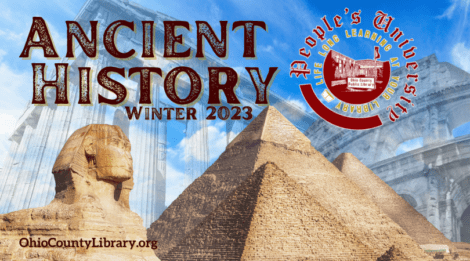
WHEELING -- The new People's University series being offered at the Ohio County Public Library in Wheeling on Thursdays beginning Jan. 5 will explore the ancient world, including Egypt, Greece, and Rome.
The eight classes begin at 7 p.m. in the library's auditorium through Feb. 23. The classes will also be livestreamed on the library's People's University Facebook and People's University YouTube channels.
The primary instructor, Laura Michele Diener, has taught ancient and medieval history at Marshall University since 2008, where she has won several awards for teaching. She received her doctorate in history from Ohio State University and has studied at Vassar College, Newnham College, Cambridge and, most recently, Vermont College of Fine Arts. She enjoys teaching classes on fascinating peoples of the past, including Vikings, Romans, Ancient Egyptians and Celts. She runs the History Club at Marshall and enjoys organizing the yearly Viking Feast and Yuletide Celebration. If you Google her, you will find some of her creative essays online. She has written about medieval spirituality, medieval embroidery and medieval hair. She is currently writing a biography of the Norwegian Nobel prize-winning writer, Sigrid Undset, titled "A World Perilous and Beautiful."
Fresh off a European lecture tour, Marie N. Pareja will teach two of the classes. She is a Bronze Age Aegean archaeologist and art historian who focuses on iconography, exchange and identity in prehistoric Afro-Eurasia.
She currently works as an assistant professor of Classical Archaeology and Religious Studies at Marshall University and as a consulting scholar for the University of Pennsylvania. Some of her most recent work has been featured in Smithsonian magazine, and her up-and-coming projects on the interconnectivity in the Neolithic and Bronze Age periods were hosted by the University of Oxford in early December 2022.
The People's University Ancient History schedule includes:
Class 1 Jan. 5 - Egypt Part 1 - Gods and Pyramids
Egypt was a superpower in the Near East for over 3,000 years. By the time Cleopatra came to the throne, the pyramids were thousands of years old, and she would have considered their builders to have been "ancient," much as we do. This class will study the glory days of truly ancient Egypt, covering the emergence of royal power, exalted gods and military might.
Class 2 Jan. 12 - Egypt Part 2 - The Pharaohs
No doubt you have heard of Cleopatra, but what about Hatshepsut, the first Egyptian woman to rule in her own right, and the one who created the word pharaoh? Or Rameses III, who was brutally assassinated by the denizens of his own harem? This class will cover some of the most colorful of the New Kingdom rulers, examining their private lives, their public personas, and their legacy in tombs and temples.
Class 3 Jan. 19 - Greece Part 1 - Minoan, Mycenean, & Homeric
The Bronze Age lasts for approximately 2,000 years - 3000-1170 BCE. During this period, we see a shift from the settled and (some still maintain) isolated cultures from Mesopotamia, Ancient Egypt, and the broader Mediterranean, to a highly-integrated, multicultural, globalized system. This will focus primarily on the Bronze Age Aegean and what we see in the iconographic and archaeological record, including the most famous sites and artworks from each region and period.
Class 4 Jan. 26 - Greece Part 2 - Archaic & Classical
With the collapse of the Bronze Age Aegean cultures in ca. 1170, Greece rested for a few hundred years in a relative dark age, neglecting and then forgetting the masterful heights of technological and artistic culture of the Middle and Late Bronze Ages. They began the slow slog back to prominence, which we will trace through the art historical record, primarily through human statuary with a few forays into some architecture and even myth. Through this lens the class will trace the rise of Greek culture from the Geometric and Archaic Periods, through the Classical period and up to the rule of Alexander the Great, in the Hellenistic period.
Class 5 Feb. 2 - Greece Part 3 - Alexander the Great & the Hellenistic Egypt
The history of Egypt changed during the fourth century BC, when the unstoppable Alexander the Great conquered the Near East and the Middle East from Greece to India, defeating the Persian Empire and uniting the most unlikely of kingdoms under his rule and those of his successors.
Class 6 Feb. 9 - Rome Part 1 - The Period of the Kings through the Republic
The Romans believed they were descended from a long line of gods and heroes. Their oldest stories celebrated the demise of tyrants, the value of shared power, and respect for family. The class will consider how these founding myths helped shape their identity as they rose from a small collective of farmer-warriors to a massive empire within the space of about 200 years.
Class 7 Feb. 16 - Rome Part 2-Rise & Fall of Empire
By the time of Julius Caesar was murdered during the Ides of March, the Romans had been living through almost a century of civil wars marked by massacres, betrayal, and upheaval. During the first century BC, the Republic had begun to break down under the pressures of expansion and ambition. In this class, we will cover the cataclysmic end of the Republic and the formation of imperial rule under Emperor Augustus and his successors. Despite its blood-soaked beginnings, the Empire ushered in a golden age of Roman peace and prosperity known as the Pax Romana.
Class 8 Feb. 23 - The Tragedy of Pompeii
Before Mount Vesuvius erupted in 79 AD, Pompeii was a thriving, dynamic, and international city whose story intertwined with the key events of Roman history. This course will consider the complex past of Pompeii before and after its cataclysmic destruction. Using unique archeological sources from graffiti to sewage, we will explore the very real people who lived, loved, and died in the most well-preserved of ancient cities.
The People's University is a free program for adults who wish to continue their education in the liberal arts. It features courses that enable patrons to pursue their goal of lifelong learning in classic subjects such as history, philosophy, and literature. Patrons may attend as many classes as they wish. There are no tests of other requirements and all programs are free and open to the public.
For more information about the People's University Ancient History or other Library programs, call 304-232-0244 or stop by the Reference Desk.