
Remediation, frustrations mark five months since derailment in East Palestine
Trending
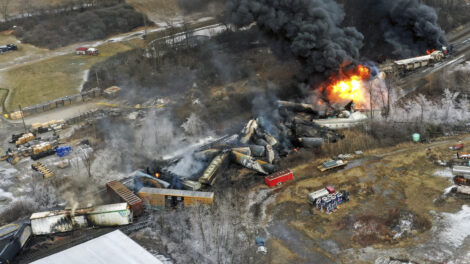
EAST PALESTINE -- Monday marked five months since a Norfolk Southern train derailed in East Palestine, and while some in the village are satisfied with the cleanup efforts and the railroad's attempts to make amends, others remain frustrated and fearful.
The road to
remediation
Last week, Norfolk Southern reported that excavation of the 1,900-linear feet of railway impacted by the derailment has undergone complete remediation and restoration. The north-bound line was reopened to traffic, marking the first time since Feb. 23 that both tracks were open to rail traffic.
The railroad initially opened both lines just days following the derailment and controlled burn by rebuilding the tracks over contaminated soil.
The decision drew outcry and criticism from residents. It also prompted the U.S. Environmental Protection Agency to send a letter to Norfolk Southern on Feb. 10, accusing the railroad of improper remediation and stating that "areas of contaminated soil and free liquids were observed and potentially covered and/or filled during reconstruction of the rail line including portions of the trench/burn pit that was used for the open burn off of vinyl chloride."
The EPA did not officially order Norfolk Southern to "conduct all necessary actions associated with the derailment cleanup" until Feb. 21.
A day after the order, Norfolk Southern announced that the south tracks would be dismantled and all soil contaminated underneath excavated. Despite the timing, Norfolk Southern CEO Alan Shaw insisted it was the community feedback that convinced the railroad to change its original remediation plans.
"It is important to me that the members of this community have confidence in Norfolk Southern's remediation efforts and that we are working closely with local, state and federal agencies," Shaw said. "An important part of this plan is to listen to the concerns of the community and that's a primary reason why we are going to enhance our plan."
Complete excavation of the first set of tracks began on March 1 but was slowed by the refusal of several licensed-disposal facilities in other states refusing to accept the derailment waste from East Palestine. The EPA stepped in again and ordered the facilities to do so, calling refusal to accept contaminated dirt from East Palestine "unlawful" under the Comprehensive Environmental Response, Compensation, and Liability Act, commonly known as the Superfund. It was the same act the EPA invoked to force Norfolk Southern to cover all costs of the cleanup.
Remediation of the south-bound tracks was completed on April 14. Cleanup work on the south-bound tracks was completed on June 27.
As of Thursday, 78,385 tons of solid waste have been removed and 22,961,970 gallons of liquid waste shipped off site.
Excavation of contaminated soil continues near the crash site, as crews moved on to the car-scrapping areas and the ditches north and south of the tracks.
"Making it Right"
Since the derailment, Norfolk Southern has donated $62.4 million dollars to the community, which Shaw has repeatedly called a "down payment" while pledging to be there for the community "for the long haul."
The reparations have included a planned $25 million park-renovation project, $250,000 donation to the Way Station, a $300,000 gift to the East Palestine City Schools, nearly $500,000 to establish four scholarships at the high school, more than $2.7 million to the East Palestine Fire Department, a $1 million budget for the community liaison to spend at his discretion, plans to restore and upgrade the outside of the East Palestine Train Depot as well as an additional $100,000 grant to East Palestine to help it use the building as the community sees fit.
Norfolk Southern also opened a permanent Family Assistance Center located at 191 E. Rebecca St. in East Palestine where the railroad reports it has "helped over 10,000 families."
In May, Norfolk Southern announced a program to compensate East Palestine homeowners for loss of property value. According to Shaw, "eligible homeowners for this compensation include those with homes within an approximately five-mile radius of the derailment, and who sell their homes for less than their property's pre-Feb, 3 appraised value."
Displaced, dejected
While many in the village have tried to move past the derailment, others find themselves unable to do so -- stuck in limbo and still unable to return to their homes.
The creeks that carve paths through East Palestine remain contaminated by both Norfolk Southern's and the EPA's accounts. Those waterways -- Sulphur and Leslie Runs -- flow next to and, in some cases, under many houses across the village. Residents who live closest to the derailment site say their houses are uninhabitable -- residents like Kristy Ferguson, Zsuzsa Gyenes, Ashley McCollum and Shelby Walker.
Walker's home is just 900 feet from the tracks and "ground zero." She feels as if she has had her home ripped away from her and her family of 11.
"How do I know that contaminated soil has not leaked closer to our home or is even in our home right now?" Walker asked during the Unity Council for East Palestine Train Derailment's community press conference in May. "Being that we are so close, my home is not safe. My kids have lost their home. They've lost their family. We are spread out everywhere."
The Unity Council for East Palestine Train Derailment was formed by local residents as a community oversight committee to the disaster's responding agencies. It was also formed to be a voice for the communities impacted by the disaster and to be an advocate for those who are experiencing adverse reactions -- respiratory and digestive issues, sore throats, rashes, headaches, bloody noses and fatigue -- in the wake of the rail disaster and chemical release.
The council traveled to Columbus in June to demand Gov. Mike DeWine make a declaration of disaster for the East Palestine area with a protest at the Ohio State Capitol. So far, DeWine has refused to, opting for two extensions from the Federal Emergency Management Agency to reserve the right to make a declaration request in the future instead.
An online petition from the Unity Council for DeWine to act on his deadline extensions has garnered more than 13,000 signatures to date.
On Monday, DeWine requested that President Joe Biden issue a presidential disaster declaration relating to derailment and release of hazardous chemicals. Monday was the deadline set by the Federal Emergency Management Agency following a previous extension request.
"The possibility remains that the voluntary support provided by Norfolk Southern could at some point in the future cease, and this declaration is needed to ensure that the state and federal government use all resources available to step in and provide the community with needed assistance," DeWine stated in his letter to Biden.
"Because of the unique nature of this incident the state is still working to identify current needs and evaluate the future impacts this disaster will have on individuals and the community," DeWine stated in the letter. "In addition to the physical and mental health impacts, there have been economic impacts. Homeowners and business have seen property value decline and loss of business as people are hesitant to come into the community."