
DeWine’s interpreter on duty in Belmont
Trending
ST. CLAIRSVILLE -- Marla Berkowitz is familiar to many who tune in to Gov. Mike DeWine's weekly public addresses.
As a sign language interpreter for deaf viewers, her energetic and animated signing is a near-constant presence during broadcasts. On Friday, however, Berkowitz was on duty in one of Belmont County's courtrooms.
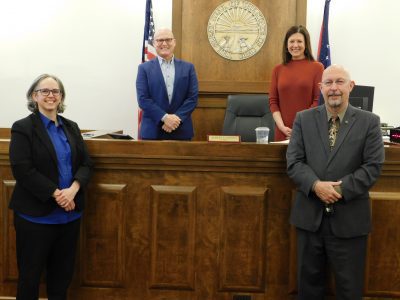
When Belmont County Juvenile Court Judge Al Davies' staff requested the Ohio Supreme Court assign an interpreter for a deaf witness Friday, Berkowitz was immediately drafted for the job. She was contacted through Hallenross & Associates sign language service and accompanied by Ben Hall, who interpreted her for those unable to read sign language. Berkowitz is Ohio's only certified deaf interpreter.
"I work with the agency all the time," she said with Hall interpreting her signs. "They gave me a call because we do all the legal work together."
Since it is a juvenile court case, no details about the hearing could be released. But afterward, Davies and Belmont County Magistrate Amy Busic spoke with Berkowitz. She said sign language in a courtroom was a welcome break from the pressure of DeWine's press briefings.
"The obvious difference is the space. There is no pausing for clarification. You can do that here, you can't do that in a press conference," Berkowitz said. "I can't interrupt, so I keep on going. It’s a rather stressful environment because you've got to chop right along. You can't slow down.
"There's a team of three of us there who work together to do those assignments," she said. "I have to make sure that I sign very clearly. I've got to look good, as best I can. It's the team of us that make it all come out right."
In answer to a question from Davies, Berkowitz added that physical emotional cues and facial expressions are an integral part of the language.
"It's part of the language. There's grammar that's written on the face. You have to use certain facial gestures to indicate a question or a statement or rhetorical timing of the statements, the intonation, that's the kind of things that are seen on body language as well as on the face."
She added that for this reason, mask mandates during the coronavirus pandemic have been an added strain to the deaf and signing community.
"It's horrible for deaf individuals," she said, adding there are apps available such as Live Translation, which can be used for simple conversations or orders at a grocery store.
"Without a mask on, I can't lip-read, I can't get facial expressions, I miss all that," she said.
Berkowitz and Hall said for many deaf people such as Berkowitz, sign language is their first language, while most interpreters learn it as a second language. She also said sign language can have as many variants and dialects as spoken language.
"I get involved because it's my first language, and I'm able to better match the deaf individual's language needs, because sign language varies from region and location, and education has influenced this. Sometimes they learn sign language, sometimes they learn lip-reading, and sometimes they learn different kinds of sign language, so it's not standardized. I'm able to provide that access more accurately than other individuals can," she said.
During the hearing, Hall signed to Berkowitz what he heard in the courtroom.
"If there's any talking or any noises or anything, they tell me about it, and I fit that into the interpretation for the deaf individual," Berkowitz said.
Busic and Davies added that the Supreme Court requires they provide an interpreter for situations such as a deaf witness or one who speaks another language.
"It's a great service, it always works very well," Davies said, adding he was impressed with Berkowitz's performance on the job. "Obviously, you don't get to the level of being the sign interpreter for the governor of the state of Ohio without having some very good expertise, training and abilities. We were really lucky that she got this assignment, and she did a phenomenal job working at the hearing."
"It really worked wonderful," Busic said. "I thought this was a really good system."