Trending
Just like that, we became "empty nesters" at our house.
Empty dove nesters, that is.
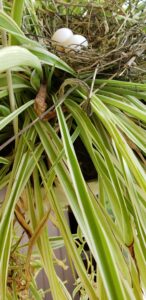
Earlier this month I wrote about a pair of mourning doves who chose a hanging spider plant on our front porch as their newest home some time before Memorial Day weekend. In that nest, the female laid a perfect pair of small, bright white eggs near the end of May.
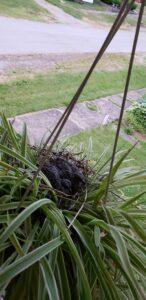
Mother Dove and Father dove took turns sitting on those eggs day after day until mid June. I came home one evening to discover that two little doves had hatched and were sitting motionless in the nest, covered in fuzzy, dark brown plumage, waiting for a parent to return and keep them warm.
My husband, Mike, and I really enjoyed watching the cycle of new life play out as we came and went from our front door. Even our family members who came to dinner on Father's Day got to watch part of the show, peeking out the front window as one of the parents went about providing a meal to their two little offspring.
Then, late this week, we arrived home to find the next completely empty. No eggs, no chicks and no parents.
It appears that the youngsters must have left the nest on their own, as there was no sign of a struggle. We saw no indication that a predator had somehow been able to reach them, and there was no evidence that the little ones had hopped out of the nest and become stranded on the ground.
So, it seems that the child rearing effort was a success.
The parent birds have not returned, as far as I can tell. Of course I continue to hear mourning doves cooing nearby, but I'm afraid that I can't identify this specific couple among them.
I'm glad we were able to provide these gentle creatures with a safe place to raise their little family. I have read that sometimes doves will return to the same nest to hatch their next brood, so I think I will leave it undisturbed for a while and see what happens. In the meantime, here are a couple of images of the process. Enjoy!