
Nursing students learn in simulated lab

T-L Photo/ROBERT A. DEFRANK Ohio University Eastern nursing students Jarrod Heskett, left, and Maria Vincenzo work with the new simulator lab and realistic mannequin.
ST. CLAIRSVILLE — Nursing students at Ohio University Eastern are learning in a setting as close to real as can be simulated in a lab, preparing them for when they are called on to respond to genuine emergencies.
As of Friday, the nursing program simulated lab is officially in operation.
Matt Fox, associate director of nursing, said the lab was designed during a six-month period and constructed in about a year. The investment was about $250,000.
“The students, they’ve been in this lab this week and in this room they’ve done a high-fidelity simulation,” he said. “Placing the students in a realistic clinical experience without caring for an actual live patient.”
Fox said there are about 10 nursing students in an average cohort.
“In the future we are planning for expanding the student and cohort sizes and we’re looking for a goal of about 25 to 30,” he said. “We’re going to be offering an obstetrics course in the fall, so that would require an expansion of the maternity simulator.”
The central piece of equipment is a high-fidelity simulator mannequin capable of speaking, crying and screaming. It can also simulate a heartbeat, pulse and other functions.
Fox said there are two rooms, one with a female simulator mannequin.
The maternity simulator would call for the addition of a mannequin that can simulate giving birth.
Fox said the students are doing well.
“We can put the ‘patient’ into experiences that they may not always encounter in a clinical setting as a nursing student. That gives them practice. For example, a cardiac arrest patient, a respiratory arrest patient, somebody that is coming in after a traumatic accident with a hemorrhage, and they’re able to manage that with this lab environment.”
Students enter the simulation lab without knowing what they will be responding to. It is up to them to assess symptoms, review “lab reports” and apply their knowledge.
Student Maria Vincenzo, junior, of St. Clairsville said the experience is very educational.
“Based on everything that we’ve learned, we come in this room like a real-life situation and we assess the patient just like real life, and it’s pretty cool, because having this type of technology it’s basically real life. It’s like you’re working on a real patient. It’s pretty impressive,” she said.
“It’s almost better than real life, because you have your instructors who are out here … and they’re watching you and any mistake you do, they’re able to now correct it. It allows them to observe,” Jarrod Heskett, a junior from St. Clairsville, said, adding it was the most realistic part of their studies besides actual clinical work.
“It really prepares you for the future,” Vincenzo said.
“You definitely see people — myself included – struggle in here, because we’re still learning,” Heskett said.
“It’s as intimidating as real-life clinical, but it definitely prepares us,” Vincenzo said. “You go in and you’re assessing him, and if you mess up, it’s OK. It’s just a simulation.”
“It’s very akin to what it’s like in a hospital system,” Heskett said. “The instructors of the course, they really do go above and beyond.”
“It’s a great program,” Vincenzo said.
Community
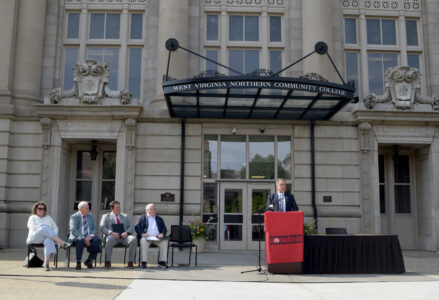
West Virginia Northern Community College celebrates rededication of historic B&O Building
Summer adult education courses available at Jefferson County JVS
BLOOMINGDALE – People looking to expand their horizons can now take part in summer adult career training at ...
Local Briefs
Martins Ferry Council meeting set MARTINS FERRY – Martins Ferry City Council is scheduled to meet in regular ...

Menjivar excited for new role as bishop

Brennan resigns as Bishop Of Wheeling-Charleston Diocese
Datebook
SONS OF ITALY UGUAGLIANZA LODGE 754 hosts a dance night from 7:30-10:30 p.m. the second Saturday of each month at ...