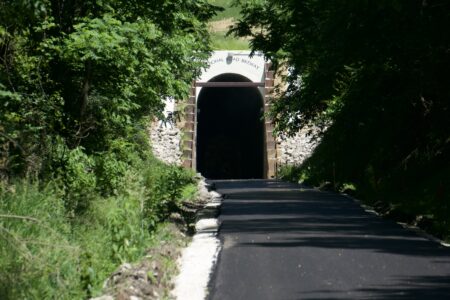
Knowlton Covered Bridge Stands Test of Time
COVERED bridges were once a common sight on the highways of America.
Early bridges were often made of wood, especially where it was a plentiful resource. Wooden bridges tended to deteriorate rapidly from exposure to the elements, having a useful lifespan of less than 10 years. Covering them protected their structural timbers, thus extending their life to upwards of 80 years or more, and thus these beautiful structures became a part of 19th century America.
The history of covered bridges can be traced back to European roots. The first covered bridge is thought to have been built in the mid-1300s between Germany and Switzerland. German immigrants brought the idea and design to this country. Covered bridges usually were named after the builders, local residents or nearby businesses, which often were working gristmills along the waterways in the vicinity of the bridges.
The bridges found in this rich, rolling farm country were often built in the tradition of barn-raising, where neighbors joined together to build a barn for a new family or to build a bridge that would serve the common good. Some bridges were constructed by mill owners and others were built by bridge companies that raised money by selling shares and later by charging tolls.
Because they were made of wood and more lasting modern concrete and steel structures replaced them, few of the original covered bridges remain today. Even in their sometimes dilapidated or poorly restored condition, these spans bear truthful witness to much that is American culture and heritage, and indeed are a National Treasure.
As recently as 1959, there were still some 1,344 authentic 19th and early 20th century covered wooden bridges standing in these United States. By June 1 1989, 492 of these had been lost to demolition, neglect or arson.
There is at least one covered bridge in 31 states. Ohio has the second largest number of such bridges with 140 and neighboring Pennsylvania boasts the most with 224 by their count in 1989. Vermont is third with 100, then Indiana with 93 and New Hampshire with 57 covered bridges. The largest concentration is in Parke County, Ill., which is home to 35 while Lancaster County, Pa., has 28 28 covered bridges. As of 2008, the longest covered bridge in the United States is the Smolen-Gulf Bridge spanning the Ashtabula River near Ashtabula, Ohio.
Locally, there are five covered bridges in Harrison County, two in Belmont County, one in Jefferson County and three in Monroe County. Most of these are recently constructed copies of the historic wooden bridges, some were rebuilt or restored; however, two in Monroe County remain mostly authentic.
The Foraker and Knowlton covered bridges both span the Little Muskingum near Graysville off scenic Ohio 26. The Foraker was built in 1886 and rebuilt in 2005. This covered bridge still carries traffic traveling along Plainview Road (Monroe 40) 92 feet over the river.
The Knowlton or Long was built the next year in 1887. This bridge is 195 feet in length and is the second longest covered bridge in Ohio. Located just off Ohio 26, it is north of Rinard Mills on Monroe 387A. It was rehabilitated in 1995 and even though no motor vehicles are allowed on the bridge, pedestrians can still walk the three-spans of the covered bridge over Little Muskingum River.
It is owned by the county and now located in Covered Bridge Park along with a picnic area where visitors can sit and admire the beauty of the architecture. The Knowlton is a covered multiple kingpost through Burr arch truss bridge and was posted to the National Register of Historic Places on March 11, 1980.
Nineteenth-century architectural ingenuity came to the fore in the design of covered bridges. Many forms of support systems were devised, but the most popular were the large arches known as the Burr truss. In 1804, Theodore Burr patented a wooden-span trussing system. The Burr arch truss combined great reinforced arches with multiple kingpost trusses. These trusses tie directly into the bridge abutments. The abutments are the stone walls at either end of the floor planking, which tie the bridge into the banks of the stream.
The stone walls that are anchored in the water and support the bridge between the abutments are the piers.
You may well wonder where does one find such a wealth of information on covered bridges. The National Society for the Preservation of Covered Bridges and The Ohio Historic Bridge Association are responsible for helping to preserve the few remaining wooden bridges and many of the other types of historic metal and stone bridges in Ohio.
The OHBA was formed in 1960 as the Southern Ohio Covered Bridge Association, specifically to preserve an abandoned covered bridge in Muskingum County, Ohio. In the early days of the Society, the principal difficulty to be overcome was convincing regional highway authorities that a particular covered wooden span ought to be preserved, if possible, not simply demolished to be replaced by a structure of modern design. More recently, however, there is no longer any question that these structures ought to be preserved, but discussions with public officials are usually centered on methods of restoration and preservation.
The National Society publishes the World Guide to Covered Bridges, a listing of all known remaining covered bridges. In addition, the National Society also puts out a quarterly magazine called Covered Bridge Topics, and a newsletter. The OHBA’s quarterly journal, Bridges & Byways, provides articles about Ohio historic bridges and recent bridge news and is available to members.
Interested readers can find additional information on covered bridges or join the association by visiting its Web site at oldohiobridges.com.
The covered bridge represents a part of our past that can never be replaced. Admirers love the beauty and tranquility of these historic bridges and want them to endure for years to come. If you have the time, stop by and see the Knowlton Bridge.
THE COVERED BRIDGE
“At rest, at last, in shaded woods,
“Wild ivy climbs its beams.
“Its memories only shared by God
“And one undying stream.
“Whose hooves have trod these ancient planks?
“What mystery would they sing?
“In raging storm was sheltered here
“Beggar, thief, or king?
“Not long ago, great artists came,
“And poets one by one.
“But soon the road was overgrown;
“Now even they are gone.
“Though now it’s only refuge to
“Wild ivy, bird, and fawn,
“The covered bridge has memories
“To cherish from now on!”
– DEB DOYLE
Published in GRIT magazine on Aug. 9, 1981.
Local News

Farewells and new beginnings at Bridgeport Schools
Sinclair Foundation voices frustrations with Belmont County Land Bank
Anti-abortion amendment rejected by Ohio AG
Ohio’s attorney general rejected language in a proposed state constitutional amendment that would eliminate a ...
Police Reports
BELMONT COUNTY SHERIFF'S OFFICE — 11:10 p.m. Monday, a caller reported hearing voices on cameras at a residence ...
Multiple departments respond to trailer fire on Weegee Road
SHADYSIDE — OR&W Fire District, Bellaire Volunteer Fire Department, Neffs Volunteer Fire Department, ...