
Barnesville police warn residents, businesses of counterfeit money
Trending
BARNESVILLE -- One local business owner is out money after an unknown person paid for items at their shop with a counterfeit $100 bill earlier this week.
The Barnesville Police Department is urging residents and businesses to remain vigilant and to be cautious of counterfeit or prop currency being used.
Though this incident was the most recent, Police Chief Rocky Sirianni said it is not the first time fraudulent money has been used at businesses in the village.
"Every once in a while we'll come across this. Typically it's not counterfeit money, it's labeled as movie prop money or just training money that you can actually purchase from eBay or Amazon. Different places will sell this for the purposes of training or for movies. It's basically just fake money," he said. "But what people will do is they'll try to take advantage of a business or somebody else by distracting the person or going when they're super busy and the employees might not check the bill close enough and just accept it. Then they're out whatever money they would have been out plus the change they gave the person."
Sirianni said a business owner turned in a "prop" $100 bill to the department Monday to alert law enforcement of the situation.
Apparently a person from "out of state" used the bill at the shop, though the staff was unable to get a license plate number of the vehicle.
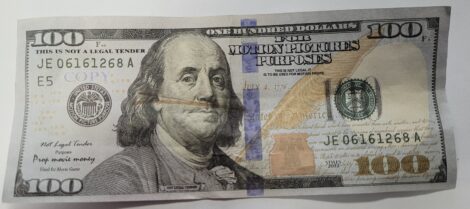
At a quick glance, the front of the bill appears real; however, when you look closer it states "For motion pictures purposes" on the top right of the bill. It also features the words "This is not a legal tender" on the top left, as well as another warning on the bottom left.
On the backside of the bill it says "For motion picture purposes" and "In prop we trust." The word "Copy" is printed on both sides.
Sirianni urges businesses and employees to look closely at bills being used by customers.
"Even if you're busy and have a lot going on or distracted, just try to take the time to at least look at both sides of a bill and swipe it with your pen if you can just to make sure you're not getting hosed by somebody because there's so many people out there that will try to take advantage of you," he said.
Sirianni said occasionally a counterfeit bill may look and feel real. He said the quickest and most efficient way to ensure that a bill is legitimate is to use a color-shifting ink pen. If the currency is legitimate, the mark made on it will turn yellow; if it is fake, the ink will turn black or dark blue. Other ways to spot counterfeit bills are by checking the following:
Watermark;
Blurry borders, printing or text;
Raised printing;
Security thread with microprinting;
Ultraviolet glow;
Red and blue threads;
Serial number.
Sirianni said some of the counterfeit currency the department has seen has said "COPY" on the bill, while others have had pink Chinese lettering or dashes on the corner of the bill.
He said some people have been criminally charged for the offense of using fake currency. If it can be proven that the person used the money willingly while knowing that it was fraudulent, he said the perpetrator can be charged with a theft offense.