Shadyside marks anniversary of deadly flood
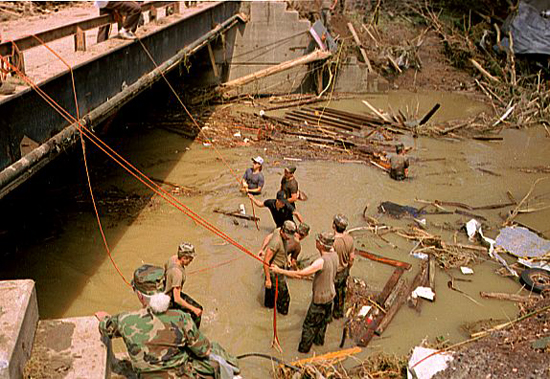
National Guard personnel assist with the cleanup from the Wegee Creek flood in 1990. After the initial disaster had passed, aid poured into the area from both in and out of state, assisting the Belmont County Emergency Management Agency and other local first responders.
SHADYSIDE — As most residents of the Ohio Valley enjoyed the summer weather Wednesday, one community recalled a deadly disaster that occurred nearly 30 years ago.
On June 14, 1990, heavy rain pounded the Ohio Valley. It is estimated that close to 3 or 4 inches fell in less than an hour, drenching the area. With hillsides and soil already soaked from wet weather that spring, the water ran off the surface into area creeks and streams, including Wegee and Pipe creeks in the Shadyside area. The result was what was described as a “wall of water” that rushed down the creeks, swallowing up cars, buildings, trees and lives. The deadly flash flood damaged or destroyed dozens of homes, and 26 resulted from the flash flooding.
Homes, vehicles and bodies were washed out into the Ohio River by the rushing water. For several days, national attention was on the Shadyside area as first responders, National Guardsmen and other volunteers struggled to help the community recover from the disaster. Eventually the physical damage to the region was repaired, but the village and those in the surrounding countryside have not forgotten the victims who lost their lives in the tragedy.
Dick Quinlin was the director of the Belmont County Emergency Management Agency at the time of the floods. When he first heard of the flash flooding, he immediately responded to the situation and soon realized just how bad the devastation was. Once he actually laid eyes on the scene, he said he could hear people calling out for help.
‘The biggest thing that was on my mind was that we had a terrible, terrible situation and at that time we didn’t know how bad it was,” Quinlin said. “I remember calling the governor at 4 in the morning to request help.”
Quinlin said that soon after he asked for help, the Ohio State Highway Patrol took him up in a helicopter to get an overhead view of the devastation. Quinlin said after he saw the flooded area from above, he feared that up to 1,000 people could have been lost.
After the initial response, Quinlin said all of the units reacting to the floods worked together and demonstrated excellent teamwork. Quinlin helped coordinate the effort among teams of law enforcement officers, National Guardsmen, firefighters and medics and other local volunteers. He added that help kept pouring in, even from out of state. The work completed during the first two days after the floods was treated as a rescue operation, with crews searching for survivors and injured people among the debris. Quinlin said that it took two days to fully account for all the people who were in the path of the floods. His job then became a recovery operation.
“The response from everybody was just fantastic. We had some great help,” he said, adding that Ormet Corp., a local aluminum producer at the time, donated thousand of dollars worth of equipment to help with the efforts along with additional manpower. Those resources came in handy in cleaning up the area in the wake of the devastation.
Quinlin said that although “you’ll never be 100 percent prepared” for such a terrible act of nature, he thinks Belmont County is in a better position to respond to such a crisis today. He has retired and been replaced by Dave Ivan but said the EMA now has a state-of-the-art communications center that can be put into service in case of a disaster. The center has enough room to function as a command center and to accommodate representatives from all responding agencies, including law enforcement, local and out-of-state fire personnel and other organizations, such as the Ohio Department of Transportation.
This represents a big improvement over the situation 27 years ago, when Quinlin said he mostly worked from the cab of his pickup truck to coordinate responding agencies. He also said that since 1990, the National Weather Service has grown and fine tuned its weather prediction software, allowing the agency to more accurately predict when and where storms will form and determine how powerful they will be. Quinlin said that the NWS was able to predict the storm that caused the flooding, but it was unable to tell just how severe the rainfall would be. Improved prediction capabilities can be vital to saving lives and property, allowing the EMA to evacuate people in case of a particularly powerful storm system or other potential disaster, he said.
Local News

Memorial Park renewal levy on May ballot
Police Reports
MARTINS FERRY POLICE Thursday 7:44 a.m. – Officers responded to Carlisle St. near N. Zane Hwy to remove debris ...
Ohio Gas prices skyrocket over last two days
After a brief reprieve, gas prices across Ohio skyrocketed more than 40 cents a gallon this week, topping $4 a ...

St. Mary’s Central School hosts annual walk-a-thon
‘Social Media incident’ triggers lockdown at St. Clairsville Schools
ST. CLAIRSVILLE – St. Clairsville-Richland City Schools were placed on a code yellow lockdown on Friday due to a ...